So after I dropped the last idea into my online bucket, I went ahead and made a brief write-up for it:
"Certain types of magic are traditional to (and generally guarded by) certain races:
Dwarves are regarded as the masters of Gem Magic, while Elves have long been the keepers of Crystal Resonance. This has lead to a feud between the two races, as the Dwarves begrudge the harvesting of quartz and other appropriate crystals for what they view as a "perversion" of Gem Magic, while the Elves say that Gem Magic was an attempt by the Dwarves to steal the knowledge of Crystal Resonance.
Halflings use Sorcery, though other races often refer to it derogatorily as Witchcraft. It is a simplistic magic, but with no less potential to be powerful.
Gnomes, with their analytical minds and love for categorizing, developed Occultism, which relies upon hidden knowledge derived from both arcane formulas and religious texts and ceremonies (which are often formulas disguised as dogma and doctrine).
Humans, with their short lifespans and overwhelming drive for power and knowledge, have not developed their own form of magic, instead learning whatever form they prefer (or can get their hands on).
It is possible to learn more than one type of magic, though finding willing teachers may be difficult."
Showing posts with label Campaign Settings. Show all posts
Showing posts with label Campaign Settings. Show all posts
Thursday, September 4, 2014

Tuesday, September 2, 2014
Demonwars: One More Thing
Something I'd intended to bring up last post, that strikes close to some of the problems I've been having with differentiating between races, is that the setting (at least in this book) doesn't have non-human PCs. Even the elves of the world, the Touel'alfar, are treated as a mysterious NPC faction that will occasionally take human children off to be trained as this game's version of the Ranger class, but is generally unseen unless they want to be seen. So you can play as an elf-trained human, but you're still human.
For the setting, this likely makes sense (again, I haven't read the books the setting is based on), but from a mechanical standpoint it also makes things less complicated and tricky, regarding balance between races and what sorts of differences they have: there are no different races for PCs, so there are no differences.
I don't know that I want to go that route, but there are times that solution seems tempting.
For the setting, this likely makes sense (again, I haven't read the books the setting is based on), but from a mechanical standpoint it also makes things less complicated and tricky, regarding balance between races and what sorts of differences they have: there are no different races for PCs, so there are no differences.
I don't know that I want to go that route, but there are times that solution seems tempting.
Monday, September 1, 2014
Gem Magic
One of the several d20 books I have on my shelves is R.A. Salvatore's Demonwars Campaign Setting book. It's got a neat flavor to it, despite that I've never read the books its based on. Definitely a lower magic setting than traditional D&D, with most hybrid classes only being permitted if they drop their spellcasting abilities, and clerics/druids/wizards/sorcerers being replaced entirely with setting-appropriate casting types based on the indigenous magic system: specially imbued gemstones.


Woo, objectification.
Sexualized cover art aside, I really like the concept of gem magic and the way it has been implemented in this system. Enough that I would use it, perhaps slightly modified, in my own games, except that as it is I'm already struggling with too many options and magic systems. I had wanted to make this system less complicated, not more, and having multiple systems of magic and spellcasting does not fit with that goal.
Regarding the setting's system, essentially there are gemstones which are imbued with magic (as well as naturally occurring gemstones that are not imbued, and can't be used to cast spells). The type of stone determines what type of magic or effects it can produce in the hands of a skilled wielder. Certain feats permit wielding two or even three stones at once, combining them to produce new effects not possible with only one gemstone.
The setting uses a mana-type system instead of spells-per-day, since you invoke the power of a stone through channeling that mana into/through it, and gem-wielding classes get 1d8 mana per level, with a bonus from their Con modifier. This still provides a limiter, which is what a spells/day system does, but there is also the secondary limiter of having any magic dependent upon having one of these special gemstones. There's no learning new spells each level, or scroll scribing giving a wizard a utilitarian edge. You either have the stone you need, or you don't - leveling just gives you more mana. Multiple gem wielders, though, can potentially share stones with each other, and I don't think there's any mention of stones breaking or losing their magical properties with use.
Combining it with any other magic system has the potential to make gem magic significantly under-powered, which means if I do want to use it, it may have to be the only magic system available. Alternatively, I could keep all these systems as options and leave it up to the players as to what gets used.
Tuesday, May 29, 2012
Racial Diversity in Gaming
Once again I'm trying to tackle the question of how much or how little difference race selection should make in the game. It seems like any explanation for giving bonuses or detriments, whether to stats, skills, or classes, is based on an attempt to propagate a stereotype of the race in question. Yet this is generally only helpful if you intend to play to the stereotype, and most players I know like to break them instead. Further, if you are playing in a system that allows you to place your ability scores as you like, rather than as you rolled them, then you're already optimizing for the class you want to play, and can manipulate the placement to either offset disadvantages or boost bonuses.
Back to the stereotyping issue: "Everyone" knows humans jack all the trades, elves are better at everything except being clerics and taking hits, dwarves are better at hitting things, getting hit, and making stuff, and sometimes being clerics, halflings are good at being sneaky, stealing anything not bolted down, and in some cases being clerics, while gnomes are the quirky alchemically-inclined arcanists. If anyone plays a half-orc, it's always optimized for bashing things. There are sub-races that break some of these rules, but generally speaking you don't see gnome barbarians, dwarven wizards, or half-orc bards. There are various "reasons" given for these things, but without the setting's background it more or less seems arbitrary. It gives a bit of flavor, another choice for the player, while still remaining (in theory) numerically balanced.
I guess what I'm getting into is flavor vs. substance. Ice cream is ice cream, but choosing chocolate, vanilla, or any of the other 47 flavors is what makes the experience personalized, unique, and memorable. Yet when it comes to race, what would be the ultimate difference between playing an elf (for example) rather than a human? If you're already placing stats as you want them, you can put your high numbers in Dex and Int if you want to play to the widespread stereotypes. Is it enough to simply state "my character is an elf?" Is roleplay the major factor, or does there need to be a mechanical variance in order to really feel like you made a defining choice in the character's development?
I spoke with my wife about some of this, and came to the conclusion that I don't like assigning racial stereotypes. Considering I'm a Sociology major, I guess this shouldn't be a surprise. I'd rather leave it up to the player to determine what stereotype, if any, they want to play to or break away from. But if there are no defined norms or stereotypes to begin with, then the player has nothing to guide him or her. Stereotypes and norms would only come about by having enough player-created characters to build them organically.
Overall, I've decided that it isn't within the scope of mechanics-building to define these things, but in setting or world-building. It is the campaign world which determines what is the norm, and mechanics are altered to suit. I could build a world where dwarves are the penultimate magic-users, elves have developed steam technology, halflings can take a severe beating and still keep going, and humans are terrible at everything except being clerics. Sure, this flies in the face of most fantasy literature, and I'd have to come up with some fairly solid reasoning and explanation for why things were that way, but there's nothing stopping me from doing so. The biggest problem with this, though, is that if I provide a setting with norms that are too different from what players expect, it will likely be (at least at first) confusing and may put them off if they don't enjoy it. If someone expects chocolate ice cream, and gets pistachio instead, they probably won't be happy.
On the far side of the moon, I remember one of my gaming books mentioning that, yes, the setting does have set and discriminatory gender roles, but that's just part of the game society and is something the character will have to deal with, either by trying to blend in or by fighting the system and trying to enact change. By creating norms and stereotypes, I'd also be providing a social contract for the characters to either adhere to or challenge, which can make for really good RP, but doesn't necessarily help me test my game mechanics.
Okay, I've gotten sidetracked here. Determining whether this is a system issue or a setting issue doesn't help me to decide what sorts of mechanical differences I should be applying.
Size is basic, and easy. Regardless of what a race is called or whatever abilities it may have, its relative size to humans is something that doesn't bug me to include. It determines non-magical weaponry available, and by 3rd Ed. also has an effect on armor class. Also by 3rd Ed. it has an effect on movement speed, and my friend brought up the effect of size on reach as well, but that tends to get into positional combat tactics that I was trying to avoid, for the most part, in system construction. There is a part of me that it appeals to, but it also can slow combat down in contrast with the system I grew up on.
Various vision types are available, with variations between editions to draw upon. It still touches on pre-existing stereotypes of what defines a race, but it's easier for me to deal with than stat boosts.
Bonuses with weapons or skills and stat bonuses, and even discounted experience costs for certain classes based on race, are things that would make mechanical differences, but are the strongest "offenders" as far as stereotyping go. Is it somehow inherently flawed or wrong if every race is capable of being just as much a jack-of-all-lanterns as humans are? Should humans have some sort of specialty as well?
Too many questions, and I've run out of pebbles for now.
Back to the stereotyping issue: "Everyone" knows humans jack all the trades, elves are better at everything except being clerics and taking hits, dwarves are better at hitting things, getting hit, and making stuff, and sometimes being clerics, halflings are good at being sneaky, stealing anything not bolted down, and in some cases being clerics, while gnomes are the quirky alchemically-inclined arcanists. If anyone plays a half-orc, it's always optimized for bashing things. There are sub-races that break some of these rules, but generally speaking you don't see gnome barbarians, dwarven wizards, or half-orc bards. There are various "reasons" given for these things, but without the setting's background it more or less seems arbitrary. It gives a bit of flavor, another choice for the player, while still remaining (in theory) numerically balanced.
I guess what I'm getting into is flavor vs. substance. Ice cream is ice cream, but choosing chocolate, vanilla, or any of the other 47 flavors is what makes the experience personalized, unique, and memorable. Yet when it comes to race, what would be the ultimate difference between playing an elf (for example) rather than a human? If you're already placing stats as you want them, you can put your high numbers in Dex and Int if you want to play to the widespread stereotypes. Is it enough to simply state "my character is an elf?" Is roleplay the major factor, or does there need to be a mechanical variance in order to really feel like you made a defining choice in the character's development?
I spoke with my wife about some of this, and came to the conclusion that I don't like assigning racial stereotypes. Considering I'm a Sociology major, I guess this shouldn't be a surprise. I'd rather leave it up to the player to determine what stereotype, if any, they want to play to or break away from. But if there are no defined norms or stereotypes to begin with, then the player has nothing to guide him or her. Stereotypes and norms would only come about by having enough player-created characters to build them organically.
Overall, I've decided that it isn't within the scope of mechanics-building to define these things, but in setting or world-building. It is the campaign world which determines what is the norm, and mechanics are altered to suit. I could build a world where dwarves are the penultimate magic-users, elves have developed steam technology, halflings can take a severe beating and still keep going, and humans are terrible at everything except being clerics. Sure, this flies in the face of most fantasy literature, and I'd have to come up with some fairly solid reasoning and explanation for why things were that way, but there's nothing stopping me from doing so. The biggest problem with this, though, is that if I provide a setting with norms that are too different from what players expect, it will likely be (at least at first) confusing and may put them off if they don't enjoy it. If someone expects chocolate ice cream, and gets pistachio instead, they probably won't be happy.
On the far side of the moon, I remember one of my gaming books mentioning that, yes, the setting does have set and discriminatory gender roles, but that's just part of the game society and is something the character will have to deal with, either by trying to blend in or by fighting the system and trying to enact change. By creating norms and stereotypes, I'd also be providing a social contract for the characters to either adhere to or challenge, which can make for really good RP, but doesn't necessarily help me test my game mechanics.
Okay, I've gotten sidetracked here. Determining whether this is a system issue or a setting issue doesn't help me to decide what sorts of mechanical differences I should be applying.
Size is basic, and easy. Regardless of what a race is called or whatever abilities it may have, its relative size to humans is something that doesn't bug me to include. It determines non-magical weaponry available, and by 3rd Ed. also has an effect on armor class. Also by 3rd Ed. it has an effect on movement speed, and my friend brought up the effect of size on reach as well, but that tends to get into positional combat tactics that I was trying to avoid, for the most part, in system construction. There is a part of me that it appeals to, but it also can slow combat down in contrast with the system I grew up on.
Various vision types are available, with variations between editions to draw upon. It still touches on pre-existing stereotypes of what defines a race, but it's easier for me to deal with than stat boosts.
Bonuses with weapons or skills and stat bonuses, and even discounted experience costs for certain classes based on race, are things that would make mechanical differences, but are the strongest "offenders" as far as stereotyping go. Is it somehow inherently flawed or wrong if every race is capable of being just as much a jack-of-all-lanterns as humans are? Should humans have some sort of specialty as well?
Too many questions, and I've run out of pebbles for now.
Wednesday, June 15, 2011
This is what happens when I have time to re-think...
So, I have the schools of magic separated into Arcane and Divine schools. Under the Divine heading, currently, I have Abjuration, Conjuration, Divination, and Necromancy. Arcane has Enchantment, Evocation, Illusion, and Transmutation.
Last night, I decided it made more sense to have Necromancy draw from Constitution for mana instead of Faith. I also began asking the question, again, of whether it should be an Arcane school instead. There are arguments both ways, since it was established pretty soundly that in order to be a "true" Necromancer, you'd have to take both Cleric and Wizard in 3rd Edition. Evil Clerics could Rebuke and Command undead, and got some undead creation and manipulation, including the Cause X Wounds spells, which heal their created and controlled minions. Wizards, despite being able to specialize in Necromancy and having access to various negative energy spells such as Vampiric Touch, didn't have much that would allow them to build and control an undead army. Since I've put everything together into the different schools, though, a Necromancer in my game would have (what I think) all the abilities a Necromancer should have access to.
But that still doesn't tell me whether it should be Arcane or Divine in origin.
If I were to make it Arcane, that would mean I had 3 Divine and 5 Arcane schools, instead of 4 of each. I don't know if that would truly be an issue, for balance or other reasons. I had moved Abjuration to Divine only somewhat recently, in order to make the number even, since it made sense that the school dealing with shielding and protection would be more Divine-based (although I guess that depends both on your view of the gods and the views of your god). I could move it back, since the two groups would be asymmetrical anyway, which would give Mage Armor back to Arcane casters, or I could move another Arcane group to Divine instead.
The Arcane schools that I could most easily see becoming Divine (aside from Necromancy) are Enchantment and Transmutation. Enchantment holds most of the iconic benediction spells, such as Bless, but then every school has spells that were originally divine, including Evocation (Flame Strike). Transmutation, though it does have some very iconic Arcane/Wizard spells, is primarily based around enhancement spells at low levels.
Or, I could scrap this whole Divine/Arcane debate entirely. Several campaign settings have already decided that ALL magic comes from the gods, in one way or another. I could simply state that there is no appreciable difference between them.
Any input on this would be appreciated.
Last night, I decided it made more sense to have Necromancy draw from Constitution for mana instead of Faith. I also began asking the question, again, of whether it should be an Arcane school instead. There are arguments both ways, since it was established pretty soundly that in order to be a "true" Necromancer, you'd have to take both Cleric and Wizard in 3rd Edition. Evil Clerics could Rebuke and Command undead, and got some undead creation and manipulation, including the Cause X Wounds spells, which heal their created and controlled minions. Wizards, despite being able to specialize in Necromancy and having access to various negative energy spells such as Vampiric Touch, didn't have much that would allow them to build and control an undead army. Since I've put everything together into the different schools, though, a Necromancer in my game would have (what I think) all the abilities a Necromancer should have access to.
But that still doesn't tell me whether it should be Arcane or Divine in origin.
If I were to make it Arcane, that would mean I had 3 Divine and 5 Arcane schools, instead of 4 of each. I don't know if that would truly be an issue, for balance or other reasons. I had moved Abjuration to Divine only somewhat recently, in order to make the number even, since it made sense that the school dealing with shielding and protection would be more Divine-based (although I guess that depends both on your view of the gods and the views of your god). I could move it back, since the two groups would be asymmetrical anyway, which would give Mage Armor back to Arcane casters, or I could move another Arcane group to Divine instead.
The Arcane schools that I could most easily see becoming Divine (aside from Necromancy) are Enchantment and Transmutation. Enchantment holds most of the iconic benediction spells, such as Bless, but then every school has spells that were originally divine, including Evocation (Flame Strike). Transmutation, though it does have some very iconic Arcane/Wizard spells, is primarily based around enhancement spells at low levels.
Or, I could scrap this whole Divine/Arcane debate entirely. Several campaign settings have already decided that ALL magic comes from the gods, in one way or another. I could simply state that there is no appreciable difference between them.
Any input on this would be appreciated.
Thursday, May 26, 2011
Step by step, inch by inch...
I now have a "course description" document (22 pages long) that does a fair job, I think, of explaining the various classes and class segments I have available in the game. There are a couple of classes which don't have all the details in that listing, due to the expected rarity of the classes and the fact that they essentially have their own spell lists and that would just be way too much to put in there.
My next project, I think, is to finally get around to a full list of equipment that isn't weaponry or armor. Which means I'm getting closer to needing a campaign idea to kick things off with.
My next project, I think, is to finally get around to a full list of equipment that isn't weaponry or armor. Which means I'm getting closer to needing a campaign idea to kick things off with.
Saturday, March 12, 2011
Freshman Year - Adventuring 101
via IMs
Since you're all new students, you end up in the same required courses with each other. During Adventuring 101, the professor is droning on and on about the merits of having the proper tools, when you get an illusory note passed to you, asking if you're interested in some shiral hunting this weekend.
xD
nuuuuuuuuuuuuuuuuuuuuuuuuuuuuuu
heh
wait is this a start of game or just how your opening it?
Good question.
After a moment, the illusory script swirls and reassembles: No? Good choice. Welcome to Lorinel. -PDL
WIIIIIIIIIIIIIIIIIN
PDL?
That's what it said. I guess I could have you roll an Intelligence or Perception check... except you don't have character stats rolled yet.
lol no i dont
All of a sudden the professor's droning stops, and he looks up at the class and lets out a much more lively, animated 'Well, let's see who's left then.' Looking around, you notice there seem to be a number of students gone, though you don't remember anyone getting up to leave.
lol. The people who thought it was a good idea.
poof.
"Excuse me professor. Not to be rude.... but what just happened?"
"What's that?"
"I saw some note... asking me a question about shirals."
"Oh did you? Passing notes in class isn't the best way to get an education... most of the time. Those of you still here are here because you passed the Dean's pop quiz, intended to cut the wheat from the chaff as it were."
"OOOHHHhhhhhh....." thinks about it for a moment.... probably b/c we are in an adventure class... some probably thought it was part of that.
WIIIIIIIIIIIIIIIIIN
PDL?
That's what it said. I guess I could have you roll an Intelligence or Perception check... except you don't have character stats rolled yet.
lol no i dont
All of a sudden the professor's droning stops, and he looks up at the class and lets out a much more lively, animated 'Well, let's see who's left then.' Looking around, you notice there seem to be a number of students gone, though you don't remember anyone getting up to leave.
lol. The people who thought it was a good idea.
poof.
"Excuse me professor. Not to be rude.... but what just happened?"
"What's that?"
"I saw some note... asking me a question about shirals."
"Oh did you? Passing notes in class isn't the best way to get an education... most of the time. Those of you still here are here because you passed the Dean's pop quiz, intended to cut the wheat from the chaff as it were."
"OOOHHHhhhhhh....." thinks about it for a moment.... probably b/c we are in an adventure class... some probably thought it was part of that.
The rest of the class continues as normal, except now in a far more interesting, often hands-on fashion.
Tuesday, March 8, 2011
Class Building Blocks: Lego or Duplo?
Seeing 41 different options on my current character class list is a lot less impressive than it should be. First off, a character without any special starting abilities, like being an awakened psion or of a particular bloodline, only has access to 35 of those options. Further, a lot of the things listed on the "Class" list are more like Class fragments. Magic has been broken up into its various Schools, and each School is taken individually. Some of the iconic abilities of various classes have been stripped away from the class, and divided up into smaller packages.
For instance, the Paladin abilities such as Detect Evil and Lay on Hands are now distributed amongst Crusader, Temple Knight, and Faith Healer. These "fragments" have a lower experience cost if taken alone, obviously, but the idea is that you can build your own adventurer. One of the fragments is simply an extra starting combat proficiency, which could be anything from another weapon proficiency to metamagic. Some of the fragments are levelable, improvable crafting "classes" such as Bowyer, Armorer, and Alchemist.
And, one is simply a "Citizen" class: no abilities, no special stuff, you get the benefits inherent to your ability scores. That was mostly just to give me something I can use for NPCs, but it could be fun to start a group off as Citizens and have them progress to other classes and abilities through training.
The image I have in my head of how all this should work seems good: a mix between a class-based and a skill-based game with enough variance and limiters that not every character is going to be able to do everything, but will have more varied abilities than a typical character in a class-based system.
I still need to finish separating the magic into schools, to make it easier to roll them, and I still need to determine a setting, at least a small area to start in. Then comes the fun part.
Sunday, March 6, 2011
Game Projects
Skill System...........................Done
Spell System..........................Done
Crafting System.....................Done
Class System..........................Done
Spell List...............................Done
Weapon List..........................Done
Armor List.............................Done
Other Equipment Lists...........Umm... no.
Combat System......................Done
Campaign Setting..................In Review
Campaign Ideas....................Way too many
Run Playtest.exe (y/N)? y
Starting Playtest.exe.........Error! Setting.ini not found! Abort, Retry, Fail?
*sigh*
Fail.
Tuesday, August 17, 2010
New Source Material
My friend Jonathan just recently visited again (yay!) and brought with him some books he picked up really cheap from his local gaming store. Three were from the same setting, called Arcanis, which is apparently now out-of-print but had been a 3rd Edition compatible campaign world. Not nearly as publicized as Forgotten Realms or Eberron, Arcanis has actually struck me as more interesting, and definitely more varied in its magic.
I've been reading through the material as I can, between doing reading and other assignments for college. Though online, they are accelerated courses, so it can still be a struggle to keep on top of things. I've pondered the option of cross-posting my written assignments here, so others can see what I'm working on, but I'd hate to have a professor do an internet search and believe I had plagiarized. It would be easy enough to prove that I hadn't, I guess, but I'm not sure I want to take the chance even so.
I've been reading through the material as I can, between doing reading and other assignments for college. Though online, they are accelerated courses, so it can still be a struggle to keep on top of things. I've pondered the option of cross-posting my written assignments here, so others can see what I'm working on, but I'd hate to have a professor do an internet search and believe I had plagiarized. It would be easy enough to prove that I hadn't, I guess, but I'm not sure I want to take the chance even so.
Sunday, July 25, 2010
Inspiration Gathering
My wife and I took our son to the library last week, and while we were there I did a bit of hunting through their shelves, trying to find some inspiration for settings and such. I discovered a few books by Margaret Weis of Dragonlance fame, though not a full set of anything. They didn't have any of Salvatore's work, either, which surprised me a bit considering his popularity.
We had arrived late, and the library was closing soon, so I didn't get a lot of time to look through things. I more or less picked this up at random:

It looked to be a blend of science fiction and fantasy, incorporating both magic and space travel. It seems to be the second in a set, possibly a trilogy, so I was a little disappointed that I hadn't been able to borrow the first, but it was easy enough to follow regardless.
Having read it, I've now settled on using Perception for Mage mana. I also have a rather nifty reason for why someone can't just take a firearm from Earth and go on a planet-hopping rampage with it. Essentially, the universe is separated into different zones, each with a different reality. Each reality has its own rules regarding physics and magic. Spaceships are built with the ability to reconfigure the way they work, in order to align themselves with the laws of each reality they pass through. If they didn't reconfigure, they would be incapable of moving past the boundary.
In the book, the closer you get to the center of the universe, the less distance there is between realities. Ships that travel near the center have to be extremely flexible to change their configurations quickly. Their crews carry swords, rather than energy weapons, guns, etc., because a sharp blade is always a sharp blade, regardless of reality.
Those who use magic must learn to manipulate the mana according to the rules of the reality they are in. They need to be able to sense the flow of mana, so that they can figure out how it is used in their current location.
While I may not be ready for an interplanetary campaign, I at least have some ideas for how I might do it, as well as some additional things to keep in mind when I come up with new worlds to explore.
We had arrived late, and the library was closing soon, so I didn't get a lot of time to look through things. I more or less picked this up at random:

It looked to be a blend of science fiction and fantasy, incorporating both magic and space travel. It seems to be the second in a set, possibly a trilogy, so I was a little disappointed that I hadn't been able to borrow the first, but it was easy enough to follow regardless.
Having read it, I've now settled on using Perception for Mage mana. I also have a rather nifty reason for why someone can't just take a firearm from Earth and go on a planet-hopping rampage with it. Essentially, the universe is separated into different zones, each with a different reality. Each reality has its own rules regarding physics and magic. Spaceships are built with the ability to reconfigure the way they work, in order to align themselves with the laws of each reality they pass through. If they didn't reconfigure, they would be incapable of moving past the boundary.
In the book, the closer you get to the center of the universe, the less distance there is between realities. Ships that travel near the center have to be extremely flexible to change their configurations quickly. Their crews carry swords, rather than energy weapons, guns, etc., because a sharp blade is always a sharp blade, regardless of reality.
Those who use magic must learn to manipulate the mana according to the rules of the reality they are in. They need to be able to sense the flow of mana, so that they can figure out how it is used in their current location.
While I may not be ready for an interplanetary campaign, I at least have some ideas for how I might do it, as well as some additional things to keep in mind when I come up with new worlds to explore.
Monday, July 19, 2010
Settings and Genres
Though I've been focused mostly on mechanics, I've also been keeping my eyes open for campaign settings and other tidbits that I hope would make the game more interesting for everyone. My friend Jonathan does his best to keep me supplied with new material to sift through, and loaned me a book based in a setting called the Iron Kingdoms.
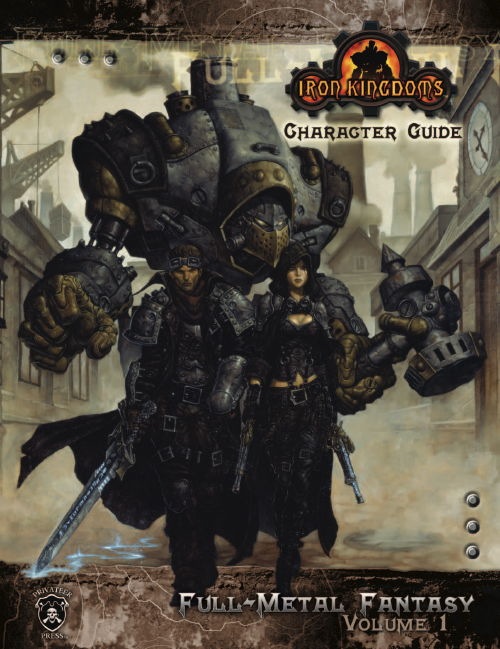
As you can tell from the cover art on the character guide, it attempts to be a blend of medieval fantasy and steampunk, and from what I can tell seems to pull it off fairly well. The concept, or at least the concept art, really appeals to me.
So I went through and pulled the weaponry from it to add to my master list of weapons, including the magical/alchemical firearms. The blasting powder and ammunition for these firearms is enclosed in a silk pouch divided into two compartments. The pin pierces the packet, letting the two magical powders mix, and the resulting explosion follows the path of least resistance down the barrel.
This is all very interesting, and very cool to introduce into a world without firearms. But it occurred to me that if interplanetary travel is possible in one's game, then there would no doubt be access to non-magical firearms, as well as much more advanced weaponry. That opens up a terribly large can of worms, since modern firearms would be (I imagine) much more powerful than even the guns in Iron Kingdoms. Bows and crossbows would fall by the wayside, or be relegated to the poorest of adventurers. The game would no longer be medieval, but instead modern fantasy or even science fiction.
I'm not opposed to those settings, mind you. I grew up with medieval fantasy, so I'm more comfortable there, but I've also played in Cyberpunk. My main concern, here, is what my players are interested in. I don't want to end up adding in more advanced technology, whether it's science or magic based (Any technology sufficiently advanced etc., etc.), and especially if it's to the detriment of the existing weaponry available, if my players would be happier retaining a medieval feel rather than a renaissance, Victorian-era, modern, post-modern apocalyptic, or space cowboy genre.
Since Jonathan provided me with the Iron Kingdoms source material, I can fairly safely assume he's comfortable with a certain level of steampunkery creeping into the game (as well as a necropolis teeming with undead, but that's another story). Knowing my wife, I'm sure she'd be comfortable with a touch of steampunk as well. So I feel mostly safe in adding in the IK weaponry. The full setting, however, doesn't mesh well with the rest of what I've set up. And I really don't want to mess with the clockwork warmachines at this juncture. So I'm still trying to dig for campaign and setting ideas, at least to start off with.
I'd like to be able to roll with any punches the group would throw at me, switch from one world/setting to another, one quest-line to another in midstream without flinching. I remember my mother telling me how she used to set up elaborate campaigns, just to have the party decide, "Nah, let's go that way instead." So now she drops groups in an established safe zone, and lets them choose where to go. Her home-brewed campaign setting, though, encompasses not just worlds, but alternate dimensions. It's large enough that it is still mostly unexplored territory. I end up feeling rather intimidated when trying to choose where to start adventuring.
So I know I need to start off small. Limit my focus to one area, with a handful of low-level campaigns, and build outwards and/or upwards from there. But I want to make sure that, despite it being a small area/low-level, it will grab the interest of my players. To that end...
Anyone have a favorite setting, genre, or concept they'd love to have a chance to play in?
As you can tell from the cover art on the character guide, it attempts to be a blend of medieval fantasy and steampunk, and from what I can tell seems to pull it off fairly well. The concept, or at least the concept art, really appeals to me.
So I went through and pulled the weaponry from it to add to my master list of weapons, including the magical/alchemical firearms. The blasting powder and ammunition for these firearms is enclosed in a silk pouch divided into two compartments. The pin pierces the packet, letting the two magical powders mix, and the resulting explosion follows the path of least resistance down the barrel.
This is all very interesting, and very cool to introduce into a world without firearms. But it occurred to me that if interplanetary travel is possible in one's game, then there would no doubt be access to non-magical firearms, as well as much more advanced weaponry. That opens up a terribly large can of worms, since modern firearms would be (I imagine) much more powerful than even the guns in Iron Kingdoms. Bows and crossbows would fall by the wayside, or be relegated to the poorest of adventurers. The game would no longer be medieval, but instead modern fantasy or even science fiction.
I'm not opposed to those settings, mind you. I grew up with medieval fantasy, so I'm more comfortable there, but I've also played in Cyberpunk. My main concern, here, is what my players are interested in. I don't want to end up adding in more advanced technology, whether it's science or magic based (Any technology sufficiently advanced etc., etc.), and especially if it's to the detriment of the existing weaponry available, if my players would be happier retaining a medieval feel rather than a renaissance, Victorian-era, modern, post-modern apocalyptic, or space cowboy genre.
Since Jonathan provided me with the Iron Kingdoms source material, I can fairly safely assume he's comfortable with a certain level of steampunkery creeping into the game (as well as a necropolis teeming with undead, but that's another story). Knowing my wife, I'm sure she'd be comfortable with a touch of steampunk as well. So I feel mostly safe in adding in the IK weaponry. The full setting, however, doesn't mesh well with the rest of what I've set up. And I really don't want to mess with the clockwork warmachines at this juncture. So I'm still trying to dig for campaign and setting ideas, at least to start off with.
I'd like to be able to roll with any punches the group would throw at me, switch from one world/setting to another, one quest-line to another in midstream without flinching. I remember my mother telling me how she used to set up elaborate campaigns, just to have the party decide, "Nah, let's go that way instead." So now she drops groups in an established safe zone, and lets them choose where to go. Her home-brewed campaign setting, though, encompasses not just worlds, but alternate dimensions. It's large enough that it is still mostly unexplored territory. I end up feeling rather intimidated when trying to choose where to start adventuring.
So I know I need to start off small. Limit my focus to one area, with a handful of low-level campaigns, and build outwards and/or upwards from there. But I want to make sure that, despite it being a small area/low-level, it will grab the interest of my players. To that end...
Anyone have a favorite setting, genre, or concept they'd love to have a chance to play in?
Subscribe to:
Posts (Atom)