Sometimes I just have to stare something in the face long enough before I can see it.
Sorcery is Arcane. Ritualism is Divine. The four schools that were under each are combined into one skill.
Is this a perfect balance? Well, no. Transmutation as a spell group has always dominated the list by the sheer number of spells it has. As it is, I'll be going through the Arcana Unearthed spells and redistributing them as I feel appropriate. Because I can do that. And I'll probably add in a few here and there that I really liked the flavor of (probably a good deal from the Arcanis system). And I'll remove the typical summoning spells, replacing them with my preferred one-shot summons, and that by itself should help balance between the two groupings.
Spellcraft as a skill would allow access to more complex magics from the other magical discipline (skill in either discipline would give access to the simple spells from any school). Exotic spells from your own discipline could be learned at ranks 3, 6, and 9, and more could be learned (from either discipline) through the use of Combat Proficiencies.
Unrelated quick thought: Base exotic weapon proficiency on a new Weaponmaster skill - each rank gives access to the exotic weapons of a different basic group (polearms, heavy blades, etc.), chosen by the player upon placing points in the skill.
Showing posts with label weapons. Show all posts
Showing posts with label weapons. Show all posts
Monday, March 25, 2013

Wednesday, June 6, 2012
Mad RP Skillz
One of the people I follow on G+ linked to this livejournal post by Monte Cook, which started me thinking about things, but it wasn't until I read one of the comments on the post by Bryan Schuder that things started clicking for me. He wrote:
Secondly, it was nice to see that my decision to try and minimize any rules based on movement and grid-style tactics is not necessarily a terrible one. I still enjoy seeing a layout, and I still enjoy having miniatures as character and monster representations, but trying to lock down how fast or far someone can move tends to only slow combat down, and if combat isn't the primary focus of the game then that seems to be a mistake.
Thirdly, while reading through this I was reminded of skill systems in both D&D and Shadowrun, and how the GM's I've played under have handled skill resolution in the past. One thing that really frustrated me (as well as other players) at the Tuesday Game(tm) Shadowrun sessions was that we, the players, were more or less limited to our own experiences and personal strong points in designing characters to play. The GM ran most non-combat skills solely through RP, whether it was a social skill in trying to bluff or negotiate, checking for traps on a closed entryway, even disabling those traps. This depended on the player having knowledge that the character should have had, or been trained for, and it meant you were pretty much incapable if you didn't have player knowledge of how to do these things. If it was combat, or a skill the GM didn't have a personal basis for judgment on, you could just roll the dice.
Don't get me wrong, I had a lot of fun at the games, and in Shadowrun, but often I would end up feeling like the points I would put into skills were wasted. Most often I played a Face/Negotiator type character, and the points I put into social skills meant I didn't have some of the machine, vehicle, or combat skills that others did. So when it came time for combat, I'd get one pistol shot and had to hope it would hit, as opposed to two or three initiative passes with machine guns or heavy artillery. Even if I took the cinematic route in combat, it still meant I'd maybe put down one baddie in the entire battle. Yet the sacrifice to my combat abilities felt meaningless, because not once did I ever pick up the dice to roll a social skill, despite having amazing dicepools in them. The only times my character would shine were at the beginning and end of a run, when the team had to meet with the contact to get the job and when we got paid, and maybe an occasional social infiltration.
Here's an anecdotal example: The proverbial poo has hit the fan, with the party down on the docks outside a warehouse. Enemy targets are everywhere, including a helicopter. Police forces are on the way, but the gates to the dock are shut and locked. Since my character can't do anything meaningful in combat anyway, I pull back and hustle to the gatehouse to find the key and unlock the gate. The GM rules it will take me X rounds to get to the gatehouse, so I'm investing a lot of time and focus into this action while everyone else is making with the fireworks. I get to the gatehouse, grab the key, and start running for the gate. One of the party members with a heavy gun of some kind manages to disable the enemy helicopter. I reach the gate just as the helicopter crash lands into it, taking the gate down entirely. I'm left standing there, key in hand, having wasted all that time doing less than nothing, rather than even the next-to-nothing I'd have done if I'd stayed in combat with my pistol. I was so invested in trying to do the thing that was seen as most helpful to the situation, that I was unable to come up with alternative methods of involving myself in the scenario which might have had more ultimate effect.
The image of my character standing there with the key in hand, staring dumbfounded at the now destroyed gate, burned itself into the minds of the players there, and everyone else got a big laugh. I grinned and bore it, then, but it has always bothered me. I had accepted the fact my character was more useful in doing this menial task than in trying to fight, and then was essentially told that no matter what I tried to do, my character's actions were entirely meaningless to the scenario. Thinking on that, and looking back now, I have to wonder how much any of the characters' actions in those runs made any difference, whether we actually made a difference to how things went or whether we were all just railroaded through the storyboards in the GM's head.
This is one of the things that I keep in mind when I think about skill systems, and one of the reasons I lean towards a "tight rules" mentality when working out the mechanics of those skills. If my players want to roleplay out a situation, that's great. I would definitely give a bonus to their skill check if I thought they did a good job. But basing the entire result on their RP, and ignoring whatever bonus they actually have to the skill, means that you never actually end up with people roleplaying their characters. Instead, they end up just playing themselves, because that's the only way to progress.
In one of my gaming groups, we had an interesting contrast that occurred that exemplifies why more constraint leads to constraint thought.
One GM started out the campaign in DnD 2nd Edtion, took it to 3.5, and then finally Pathfinder. To give him a break during the big changes and reworkings, I'd get to GM and prototype my game system and setting. My system is designed to be loose and admits to have gaps in coverage, but with the understanding that those are taken care of by things outside the core rules (game master or setting specific rulings). It was a blast, my players got to play all kinds of crazy characters (even players with no real combat skills that actually saved the day many, many times), do wild things (nano-tech infested player hijacks a pre-fall robot to distract and wrestle another robot infested with extra-dimensional bacteria.. while all the other players are trying to gun it down), and they felt their creativity would be greatly rewarded. (You know that hijacked pre-fall robot? They took it with them. It has it's own trailer. They used it to loot plasma cannons off of the turrets they disabled.) I'm an on-the-fly GM, so stick with outlines and let the players fill in the rest.
The interesting part came when we switched back to the other GM's campaign. Finally, in a discussion about tactics, the GM spouted, "Why don't you do crazy stuff in my game like you do in his game?" A player responded, "Well, in DnD there's all these rules and we try to do crazy cool stuff and it never works or we just can't do it." While I had a grin on my face, that statement stuck with me.
If your rules prevent anything outside their explicit domain from happening, players are going to naturally trend towards sticking within them. It's simple game theory; if no reward is had for an action, it will occur with decreasing frequency. Another situation came when our group tried out grid combat. While it allowed everything to be laid out well, our groups tendencies towards cool, creative ideas decreased quite rapidly. This bothered the GM and so we got rid of exact dimensions combat. After some testing, he went with the "not-to-scale minimap" setup. Allows the group to understand the layout, but not feel they are constrained to it any arbitrary movement rules. The creativity came back and all was good.First off, this helps me to realize that it might be okay to not have everything accounted for in the rules. My focus on playtesting was spurred by concerns about powergamers, rules lawyers, and just generally those people who would try to take advantage of any system, no matter how well designed. But honestly, the chances of me ever publishing whatever system I end up with are slim at best, and I don't see my playerbase growing at any point in the near future, so chances are good I can stop worrying about playtesting and just start playing.
Secondly, it was nice to see that my decision to try and minimize any rules based on movement and grid-style tactics is not necessarily a terrible one. I still enjoy seeing a layout, and I still enjoy having miniatures as character and monster representations, but trying to lock down how fast or far someone can move tends to only slow combat down, and if combat isn't the primary focus of the game then that seems to be a mistake.
Thirdly, while reading through this I was reminded of skill systems in both D&D and Shadowrun, and how the GM's I've played under have handled skill resolution in the past. One thing that really frustrated me (as well as other players) at the Tuesday Game(tm) Shadowrun sessions was that we, the players, were more or less limited to our own experiences and personal strong points in designing characters to play. The GM ran most non-combat skills solely through RP, whether it was a social skill in trying to bluff or negotiate, checking for traps on a closed entryway, even disabling those traps. This depended on the player having knowledge that the character should have had, or been trained for, and it meant you were pretty much incapable if you didn't have player knowledge of how to do these things. If it was combat, or a skill the GM didn't have a personal basis for judgment on, you could just roll the dice.
Don't get me wrong, I had a lot of fun at the games, and in Shadowrun, but often I would end up feeling like the points I would put into skills were wasted. Most often I played a Face/Negotiator type character, and the points I put into social skills meant I didn't have some of the machine, vehicle, or combat skills that others did. So when it came time for combat, I'd get one pistol shot and had to hope it would hit, as opposed to two or three initiative passes with machine guns or heavy artillery. Even if I took the cinematic route in combat, it still meant I'd maybe put down one baddie in the entire battle. Yet the sacrifice to my combat abilities felt meaningless, because not once did I ever pick up the dice to roll a social skill, despite having amazing dicepools in them. The only times my character would shine were at the beginning and end of a run, when the team had to meet with the contact to get the job and when we got paid, and maybe an occasional social infiltration.
Here's an anecdotal example: The proverbial poo has hit the fan, with the party down on the docks outside a warehouse. Enemy targets are everywhere, including a helicopter. Police forces are on the way, but the gates to the dock are shut and locked. Since my character can't do anything meaningful in combat anyway, I pull back and hustle to the gatehouse to find the key and unlock the gate. The GM rules it will take me X rounds to get to the gatehouse, so I'm investing a lot of time and focus into this action while everyone else is making with the fireworks. I get to the gatehouse, grab the key, and start running for the gate. One of the party members with a heavy gun of some kind manages to disable the enemy helicopter. I reach the gate just as the helicopter crash lands into it, taking the gate down entirely. I'm left standing there, key in hand, having wasted all that time doing less than nothing, rather than even the next-to-nothing I'd have done if I'd stayed in combat with my pistol. I was so invested in trying to do the thing that was seen as most helpful to the situation, that I was unable to come up with alternative methods of involving myself in the scenario which might have had more ultimate effect.
The image of my character standing there with the key in hand, staring dumbfounded at the now destroyed gate, burned itself into the minds of the players there, and everyone else got a big laugh. I grinned and bore it, then, but it has always bothered me. I had accepted the fact my character was more useful in doing this menial task than in trying to fight, and then was essentially told that no matter what I tried to do, my character's actions were entirely meaningless to the scenario. Thinking on that, and looking back now, I have to wonder how much any of the characters' actions in those runs made any difference, whether we actually made a difference to how things went or whether we were all just railroaded through the storyboards in the GM's head.
This is one of the things that I keep in mind when I think about skill systems, and one of the reasons I lean towards a "tight rules" mentality when working out the mechanics of those skills. If my players want to roleplay out a situation, that's great. I would definitely give a bonus to their skill check if I thought they did a good job. But basing the entire result on their RP, and ignoring whatever bonus they actually have to the skill, means that you never actually end up with people roleplaying their characters. Instead, they end up just playing themselves, because that's the only way to progress.
Tuesday, May 29, 2012
Racial Diversity in Gaming
Once again I'm trying to tackle the question of how much or how little difference race selection should make in the game. It seems like any explanation for giving bonuses or detriments, whether to stats, skills, or classes, is based on an attempt to propagate a stereotype of the race in question. Yet this is generally only helpful if you intend to play to the stereotype, and most players I know like to break them instead. Further, if you are playing in a system that allows you to place your ability scores as you like, rather than as you rolled them, then you're already optimizing for the class you want to play, and can manipulate the placement to either offset disadvantages or boost bonuses.
Back to the stereotyping issue: "Everyone" knows humans jack all the trades, elves are better at everything except being clerics and taking hits, dwarves are better at hitting things, getting hit, and making stuff, and sometimes being clerics, halflings are good at being sneaky, stealing anything not bolted down, and in some cases being clerics, while gnomes are the quirky alchemically-inclined arcanists. If anyone plays a half-orc, it's always optimized for bashing things. There are sub-races that break some of these rules, but generally speaking you don't see gnome barbarians, dwarven wizards, or half-orc bards. There are various "reasons" given for these things, but without the setting's background it more or less seems arbitrary. It gives a bit of flavor, another choice for the player, while still remaining (in theory) numerically balanced.
I guess what I'm getting into is flavor vs. substance. Ice cream is ice cream, but choosing chocolate, vanilla, or any of the other 47 flavors is what makes the experience personalized, unique, and memorable. Yet when it comes to race, what would be the ultimate difference between playing an elf (for example) rather than a human? If you're already placing stats as you want them, you can put your high numbers in Dex and Int if you want to play to the widespread stereotypes. Is it enough to simply state "my character is an elf?" Is roleplay the major factor, or does there need to be a mechanical variance in order to really feel like you made a defining choice in the character's development?
I spoke with my wife about some of this, and came to the conclusion that I don't like assigning racial stereotypes. Considering I'm a Sociology major, I guess this shouldn't be a surprise. I'd rather leave it up to the player to determine what stereotype, if any, they want to play to or break away from. But if there are no defined norms or stereotypes to begin with, then the player has nothing to guide him or her. Stereotypes and norms would only come about by having enough player-created characters to build them organically.
Overall, I've decided that it isn't within the scope of mechanics-building to define these things, but in setting or world-building. It is the campaign world which determines what is the norm, and mechanics are altered to suit. I could build a world where dwarves are the penultimate magic-users, elves have developed steam technology, halflings can take a severe beating and still keep going, and humans are terrible at everything except being clerics. Sure, this flies in the face of most fantasy literature, and I'd have to come up with some fairly solid reasoning and explanation for why things were that way, but there's nothing stopping me from doing so. The biggest problem with this, though, is that if I provide a setting with norms that are too different from what players expect, it will likely be (at least at first) confusing and may put them off if they don't enjoy it. If someone expects chocolate ice cream, and gets pistachio instead, they probably won't be happy.
On the far side of the moon, I remember one of my gaming books mentioning that, yes, the setting does have set and discriminatory gender roles, but that's just part of the game society and is something the character will have to deal with, either by trying to blend in or by fighting the system and trying to enact change. By creating norms and stereotypes, I'd also be providing a social contract for the characters to either adhere to or challenge, which can make for really good RP, but doesn't necessarily help me test my game mechanics.
Okay, I've gotten sidetracked here. Determining whether this is a system issue or a setting issue doesn't help me to decide what sorts of mechanical differences I should be applying.
Size is basic, and easy. Regardless of what a race is called or whatever abilities it may have, its relative size to humans is something that doesn't bug me to include. It determines non-magical weaponry available, and by 3rd Ed. also has an effect on armor class. Also by 3rd Ed. it has an effect on movement speed, and my friend brought up the effect of size on reach as well, but that tends to get into positional combat tactics that I was trying to avoid, for the most part, in system construction. There is a part of me that it appeals to, but it also can slow combat down in contrast with the system I grew up on.
Various vision types are available, with variations between editions to draw upon. It still touches on pre-existing stereotypes of what defines a race, but it's easier for me to deal with than stat boosts.
Bonuses with weapons or skills and stat bonuses, and even discounted experience costs for certain classes based on race, are things that would make mechanical differences, but are the strongest "offenders" as far as stereotyping go. Is it somehow inherently flawed or wrong if every race is capable of being just as much a jack-of-all-lanterns as humans are? Should humans have some sort of specialty as well?
Too many questions, and I've run out of pebbles for now.
Back to the stereotyping issue: "Everyone" knows humans jack all the trades, elves are better at everything except being clerics and taking hits, dwarves are better at hitting things, getting hit, and making stuff, and sometimes being clerics, halflings are good at being sneaky, stealing anything not bolted down, and in some cases being clerics, while gnomes are the quirky alchemically-inclined arcanists. If anyone plays a half-orc, it's always optimized for bashing things. There are sub-races that break some of these rules, but generally speaking you don't see gnome barbarians, dwarven wizards, or half-orc bards. There are various "reasons" given for these things, but without the setting's background it more or less seems arbitrary. It gives a bit of flavor, another choice for the player, while still remaining (in theory) numerically balanced.
I guess what I'm getting into is flavor vs. substance. Ice cream is ice cream, but choosing chocolate, vanilla, or any of the other 47 flavors is what makes the experience personalized, unique, and memorable. Yet when it comes to race, what would be the ultimate difference between playing an elf (for example) rather than a human? If you're already placing stats as you want them, you can put your high numbers in Dex and Int if you want to play to the widespread stereotypes. Is it enough to simply state "my character is an elf?" Is roleplay the major factor, or does there need to be a mechanical variance in order to really feel like you made a defining choice in the character's development?
I spoke with my wife about some of this, and came to the conclusion that I don't like assigning racial stereotypes. Considering I'm a Sociology major, I guess this shouldn't be a surprise. I'd rather leave it up to the player to determine what stereotype, if any, they want to play to or break away from. But if there are no defined norms or stereotypes to begin with, then the player has nothing to guide him or her. Stereotypes and norms would only come about by having enough player-created characters to build them organically.
Overall, I've decided that it isn't within the scope of mechanics-building to define these things, but in setting or world-building. It is the campaign world which determines what is the norm, and mechanics are altered to suit. I could build a world where dwarves are the penultimate magic-users, elves have developed steam technology, halflings can take a severe beating and still keep going, and humans are terrible at everything except being clerics. Sure, this flies in the face of most fantasy literature, and I'd have to come up with some fairly solid reasoning and explanation for why things were that way, but there's nothing stopping me from doing so. The biggest problem with this, though, is that if I provide a setting with norms that are too different from what players expect, it will likely be (at least at first) confusing and may put them off if they don't enjoy it. If someone expects chocolate ice cream, and gets pistachio instead, they probably won't be happy.
On the far side of the moon, I remember one of my gaming books mentioning that, yes, the setting does have set and discriminatory gender roles, but that's just part of the game society and is something the character will have to deal with, either by trying to blend in or by fighting the system and trying to enact change. By creating norms and stereotypes, I'd also be providing a social contract for the characters to either adhere to or challenge, which can make for really good RP, but doesn't necessarily help me test my game mechanics.
Okay, I've gotten sidetracked here. Determining whether this is a system issue or a setting issue doesn't help me to decide what sorts of mechanical differences I should be applying.
Size is basic, and easy. Regardless of what a race is called or whatever abilities it may have, its relative size to humans is something that doesn't bug me to include. It determines non-magical weaponry available, and by 3rd Ed. also has an effect on armor class. Also by 3rd Ed. it has an effect on movement speed, and my friend brought up the effect of size on reach as well, but that tends to get into positional combat tactics that I was trying to avoid, for the most part, in system construction. There is a part of me that it appeals to, but it also can slow combat down in contrast with the system I grew up on.
Various vision types are available, with variations between editions to draw upon. It still touches on pre-existing stereotypes of what defines a race, but it's easier for me to deal with than stat boosts.
Bonuses with weapons or skills and stat bonuses, and even discounted experience costs for certain classes based on race, are things that would make mechanical differences, but are the strongest "offenders" as far as stereotyping go. Is it somehow inherently flawed or wrong if every race is capable of being just as much a jack-of-all-lanterns as humans are? Should humans have some sort of specialty as well?
Too many questions, and I've run out of pebbles for now.
Monday, July 19, 2010
Settings and Genres
Though I've been focused mostly on mechanics, I've also been keeping my eyes open for campaign settings and other tidbits that I hope would make the game more interesting for everyone. My friend Jonathan does his best to keep me supplied with new material to sift through, and loaned me a book based in a setting called the Iron Kingdoms.
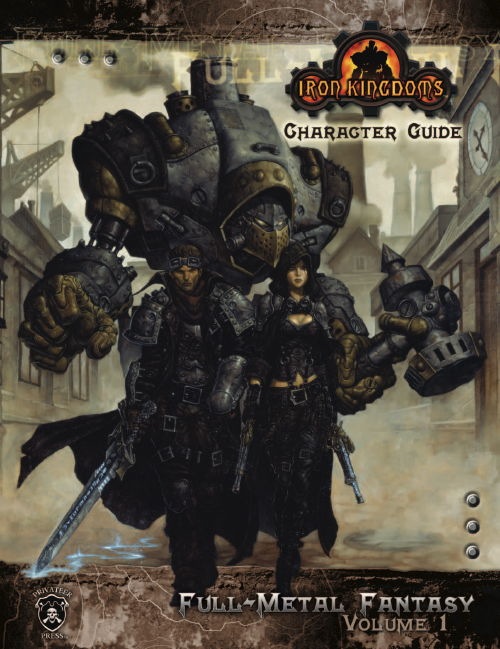
As you can tell from the cover art on the character guide, it attempts to be a blend of medieval fantasy and steampunk, and from what I can tell seems to pull it off fairly well. The concept, or at least the concept art, really appeals to me.
So I went through and pulled the weaponry from it to add to my master list of weapons, including the magical/alchemical firearms. The blasting powder and ammunition for these firearms is enclosed in a silk pouch divided into two compartments. The pin pierces the packet, letting the two magical powders mix, and the resulting explosion follows the path of least resistance down the barrel.
This is all very interesting, and very cool to introduce into a world without firearms. But it occurred to me that if interplanetary travel is possible in one's game, then there would no doubt be access to non-magical firearms, as well as much more advanced weaponry. That opens up a terribly large can of worms, since modern firearms would be (I imagine) much more powerful than even the guns in Iron Kingdoms. Bows and crossbows would fall by the wayside, or be relegated to the poorest of adventurers. The game would no longer be medieval, but instead modern fantasy or even science fiction.
I'm not opposed to those settings, mind you. I grew up with medieval fantasy, so I'm more comfortable there, but I've also played in Cyberpunk. My main concern, here, is what my players are interested in. I don't want to end up adding in more advanced technology, whether it's science or magic based (Any technology sufficiently advanced etc., etc.), and especially if it's to the detriment of the existing weaponry available, if my players would be happier retaining a medieval feel rather than a renaissance, Victorian-era, modern, post-modern apocalyptic, or space cowboy genre.
Since Jonathan provided me with the Iron Kingdoms source material, I can fairly safely assume he's comfortable with a certain level of steampunkery creeping into the game (as well as a necropolis teeming with undead, but that's another story). Knowing my wife, I'm sure she'd be comfortable with a touch of steampunk as well. So I feel mostly safe in adding in the IK weaponry. The full setting, however, doesn't mesh well with the rest of what I've set up. And I really don't want to mess with the clockwork warmachines at this juncture. So I'm still trying to dig for campaign and setting ideas, at least to start off with.
I'd like to be able to roll with any punches the group would throw at me, switch from one world/setting to another, one quest-line to another in midstream without flinching. I remember my mother telling me how she used to set up elaborate campaigns, just to have the party decide, "Nah, let's go that way instead." So now she drops groups in an established safe zone, and lets them choose where to go. Her home-brewed campaign setting, though, encompasses not just worlds, but alternate dimensions. It's large enough that it is still mostly unexplored territory. I end up feeling rather intimidated when trying to choose where to start adventuring.
So I know I need to start off small. Limit my focus to one area, with a handful of low-level campaigns, and build outwards and/or upwards from there. But I want to make sure that, despite it being a small area/low-level, it will grab the interest of my players. To that end...
Anyone have a favorite setting, genre, or concept they'd love to have a chance to play in?
As you can tell from the cover art on the character guide, it attempts to be a blend of medieval fantasy and steampunk, and from what I can tell seems to pull it off fairly well. The concept, or at least the concept art, really appeals to me.
So I went through and pulled the weaponry from it to add to my master list of weapons, including the magical/alchemical firearms. The blasting powder and ammunition for these firearms is enclosed in a silk pouch divided into two compartments. The pin pierces the packet, letting the two magical powders mix, and the resulting explosion follows the path of least resistance down the barrel.
This is all very interesting, and very cool to introduce into a world without firearms. But it occurred to me that if interplanetary travel is possible in one's game, then there would no doubt be access to non-magical firearms, as well as much more advanced weaponry. That opens up a terribly large can of worms, since modern firearms would be (I imagine) much more powerful than even the guns in Iron Kingdoms. Bows and crossbows would fall by the wayside, or be relegated to the poorest of adventurers. The game would no longer be medieval, but instead modern fantasy or even science fiction.
I'm not opposed to those settings, mind you. I grew up with medieval fantasy, so I'm more comfortable there, but I've also played in Cyberpunk. My main concern, here, is what my players are interested in. I don't want to end up adding in more advanced technology, whether it's science or magic based (Any technology sufficiently advanced etc., etc.), and especially if it's to the detriment of the existing weaponry available, if my players would be happier retaining a medieval feel rather than a renaissance, Victorian-era, modern, post-modern apocalyptic, or space cowboy genre.
Since Jonathan provided me with the Iron Kingdoms source material, I can fairly safely assume he's comfortable with a certain level of steampunkery creeping into the game (as well as a necropolis teeming with undead, but that's another story). Knowing my wife, I'm sure she'd be comfortable with a touch of steampunk as well. So I feel mostly safe in adding in the IK weaponry. The full setting, however, doesn't mesh well with the rest of what I've set up. And I really don't want to mess with the clockwork warmachines at this juncture. So I'm still trying to dig for campaign and setting ideas, at least to start off with.
I'd like to be able to roll with any punches the group would throw at me, switch from one world/setting to another, one quest-line to another in midstream without flinching. I remember my mother telling me how she used to set up elaborate campaigns, just to have the party decide, "Nah, let's go that way instead." So now she drops groups in an established safe zone, and lets them choose where to go. Her home-brewed campaign setting, though, encompasses not just worlds, but alternate dimensions. It's large enough that it is still mostly unexplored territory. I end up feeling rather intimidated when trying to choose where to start adventuring.
So I know I need to start off small. Limit my focus to one area, with a handful of low-level campaigns, and build outwards and/or upwards from there. But I want to make sure that, despite it being a small area/low-level, it will grab the interest of my players. To that end...
Anyone have a favorite setting, genre, or concept they'd love to have a chance to play in?
Subscribe to:
Posts (Atom)