So, I've scrapped the entirety of my magic system, including the compendium list of spells that I'd accumulated, and replaced it with a free-form system somewhat reminiscent of the casting system in Fabletop or the skill and magic system in Shadowrun. For purposes of nostalgia (and because I'm not ready to scrap my list of weaponry and make all weapons of any given size equal), I still have physical combat within the d20 set-up.
So how does this make things simpler?
I have some basic rules for how spells work, and how adding on different effects increases the cost of any given spell on casting. But by making the magic system entirely free-form I eliminate the need for resource books. No more looking up spell descriptions.
It makes it potentially more powerful, sure. High-powered mages have always been powerful. And there's still the limiter of "I'm the DM," plus the added bonus that a player can't point to the rulebook and say "but, but, but!" Plus, it gives the player an excuse to roll a whole bunch of six-siders, which is always fun.
My test subje-erm... game tester has brought up the concern that it can be easier on the player to have a list of spells to work from, the idea that you can look in your toolbox and see what you've got. And while there is some truth there, if a player wanted to they could write down spells they've used or come up with to refer from later on as well. I think the potential for versatility and accessibility outweighs that particular bonus. Plus, I've already come up with a short list of example spells that simulate well-known effects, so if someone says "well what can I do?" I can hand them that list.
Another aspect of this free-form system is that it means any caster can cast any spell. Healing, direct-damage, buffs/debuffs, whatever, is free game. Because as I've discussed here before, the idea that any given person can't figure out how to make a spell work in their own tradition is a bit weak. So I have two spellcasting traditions, Arcanist and Spiritualist. You can claim the power comes from a potato on a string around your neck, if you like - the only mechanical difference is which of the two spellcasting stats you use for your primary.
This free-form system will also work for psionics, and I have the mechanics in place to support a psionic system, but psionics have always been a bit game-breaking as far as power goes, primarily due to the general non-existence of psionic-resistant monsters. I'm thinking I may keep psionic ability as a rarity, rolled at character generation, as my mother does it.
Showing posts with label fun. Show all posts
Showing posts with label fun. Show all posts
Thursday, February 20, 2014

Wednesday, June 6, 2012
Mad RP Skillz
One of the people I follow on G+ linked to this livejournal post by Monte Cook, which started me thinking about things, but it wasn't until I read one of the comments on the post by Bryan Schuder that things started clicking for me. He wrote:
Secondly, it was nice to see that my decision to try and minimize any rules based on movement and grid-style tactics is not necessarily a terrible one. I still enjoy seeing a layout, and I still enjoy having miniatures as character and monster representations, but trying to lock down how fast or far someone can move tends to only slow combat down, and if combat isn't the primary focus of the game then that seems to be a mistake.
Thirdly, while reading through this I was reminded of skill systems in both D&D and Shadowrun, and how the GM's I've played under have handled skill resolution in the past. One thing that really frustrated me (as well as other players) at the Tuesday Game(tm) Shadowrun sessions was that we, the players, were more or less limited to our own experiences and personal strong points in designing characters to play. The GM ran most non-combat skills solely through RP, whether it was a social skill in trying to bluff or negotiate, checking for traps on a closed entryway, even disabling those traps. This depended on the player having knowledge that the character should have had, or been trained for, and it meant you were pretty much incapable if you didn't have player knowledge of how to do these things. If it was combat, or a skill the GM didn't have a personal basis for judgment on, you could just roll the dice.
Don't get me wrong, I had a lot of fun at the games, and in Shadowrun, but often I would end up feeling like the points I would put into skills were wasted. Most often I played a Face/Negotiator type character, and the points I put into social skills meant I didn't have some of the machine, vehicle, or combat skills that others did. So when it came time for combat, I'd get one pistol shot and had to hope it would hit, as opposed to two or three initiative passes with machine guns or heavy artillery. Even if I took the cinematic route in combat, it still meant I'd maybe put down one baddie in the entire battle. Yet the sacrifice to my combat abilities felt meaningless, because not once did I ever pick up the dice to roll a social skill, despite having amazing dicepools in them. The only times my character would shine were at the beginning and end of a run, when the team had to meet with the contact to get the job and when we got paid, and maybe an occasional social infiltration.
Here's an anecdotal example: The proverbial poo has hit the fan, with the party down on the docks outside a warehouse. Enemy targets are everywhere, including a helicopter. Police forces are on the way, but the gates to the dock are shut and locked. Since my character can't do anything meaningful in combat anyway, I pull back and hustle to the gatehouse to find the key and unlock the gate. The GM rules it will take me X rounds to get to the gatehouse, so I'm investing a lot of time and focus into this action while everyone else is making with the fireworks. I get to the gatehouse, grab the key, and start running for the gate. One of the party members with a heavy gun of some kind manages to disable the enemy helicopter. I reach the gate just as the helicopter crash lands into it, taking the gate down entirely. I'm left standing there, key in hand, having wasted all that time doing less than nothing, rather than even the next-to-nothing I'd have done if I'd stayed in combat with my pistol. I was so invested in trying to do the thing that was seen as most helpful to the situation, that I was unable to come up with alternative methods of involving myself in the scenario which might have had more ultimate effect.
The image of my character standing there with the key in hand, staring dumbfounded at the now destroyed gate, burned itself into the minds of the players there, and everyone else got a big laugh. I grinned and bore it, then, but it has always bothered me. I had accepted the fact my character was more useful in doing this menial task than in trying to fight, and then was essentially told that no matter what I tried to do, my character's actions were entirely meaningless to the scenario. Thinking on that, and looking back now, I have to wonder how much any of the characters' actions in those runs made any difference, whether we actually made a difference to how things went or whether we were all just railroaded through the storyboards in the GM's head.
This is one of the things that I keep in mind when I think about skill systems, and one of the reasons I lean towards a "tight rules" mentality when working out the mechanics of those skills. If my players want to roleplay out a situation, that's great. I would definitely give a bonus to their skill check if I thought they did a good job. But basing the entire result on their RP, and ignoring whatever bonus they actually have to the skill, means that you never actually end up with people roleplaying their characters. Instead, they end up just playing themselves, because that's the only way to progress.
In one of my gaming groups, we had an interesting contrast that occurred that exemplifies why more constraint leads to constraint thought.
One GM started out the campaign in DnD 2nd Edtion, took it to 3.5, and then finally Pathfinder. To give him a break during the big changes and reworkings, I'd get to GM and prototype my game system and setting. My system is designed to be loose and admits to have gaps in coverage, but with the understanding that those are taken care of by things outside the core rules (game master or setting specific rulings). It was a blast, my players got to play all kinds of crazy characters (even players with no real combat skills that actually saved the day many, many times), do wild things (nano-tech infested player hijacks a pre-fall robot to distract and wrestle another robot infested with extra-dimensional bacteria.. while all the other players are trying to gun it down), and they felt their creativity would be greatly rewarded. (You know that hijacked pre-fall robot? They took it with them. It has it's own trailer. They used it to loot plasma cannons off of the turrets they disabled.) I'm an on-the-fly GM, so stick with outlines and let the players fill in the rest.
The interesting part came when we switched back to the other GM's campaign. Finally, in a discussion about tactics, the GM spouted, "Why don't you do crazy stuff in my game like you do in his game?" A player responded, "Well, in DnD there's all these rules and we try to do crazy cool stuff and it never works or we just can't do it." While I had a grin on my face, that statement stuck with me.
If your rules prevent anything outside their explicit domain from happening, players are going to naturally trend towards sticking within them. It's simple game theory; if no reward is had for an action, it will occur with decreasing frequency. Another situation came when our group tried out grid combat. While it allowed everything to be laid out well, our groups tendencies towards cool, creative ideas decreased quite rapidly. This bothered the GM and so we got rid of exact dimensions combat. After some testing, he went with the "not-to-scale minimap" setup. Allows the group to understand the layout, but not feel they are constrained to it any arbitrary movement rules. The creativity came back and all was good.First off, this helps me to realize that it might be okay to not have everything accounted for in the rules. My focus on playtesting was spurred by concerns about powergamers, rules lawyers, and just generally those people who would try to take advantage of any system, no matter how well designed. But honestly, the chances of me ever publishing whatever system I end up with are slim at best, and I don't see my playerbase growing at any point in the near future, so chances are good I can stop worrying about playtesting and just start playing.
Secondly, it was nice to see that my decision to try and minimize any rules based on movement and grid-style tactics is not necessarily a terrible one. I still enjoy seeing a layout, and I still enjoy having miniatures as character and monster representations, but trying to lock down how fast or far someone can move tends to only slow combat down, and if combat isn't the primary focus of the game then that seems to be a mistake.
Thirdly, while reading through this I was reminded of skill systems in both D&D and Shadowrun, and how the GM's I've played under have handled skill resolution in the past. One thing that really frustrated me (as well as other players) at the Tuesday Game(tm) Shadowrun sessions was that we, the players, were more or less limited to our own experiences and personal strong points in designing characters to play. The GM ran most non-combat skills solely through RP, whether it was a social skill in trying to bluff or negotiate, checking for traps on a closed entryway, even disabling those traps. This depended on the player having knowledge that the character should have had, or been trained for, and it meant you were pretty much incapable if you didn't have player knowledge of how to do these things. If it was combat, or a skill the GM didn't have a personal basis for judgment on, you could just roll the dice.
Don't get me wrong, I had a lot of fun at the games, and in Shadowrun, but often I would end up feeling like the points I would put into skills were wasted. Most often I played a Face/Negotiator type character, and the points I put into social skills meant I didn't have some of the machine, vehicle, or combat skills that others did. So when it came time for combat, I'd get one pistol shot and had to hope it would hit, as opposed to two or three initiative passes with machine guns or heavy artillery. Even if I took the cinematic route in combat, it still meant I'd maybe put down one baddie in the entire battle. Yet the sacrifice to my combat abilities felt meaningless, because not once did I ever pick up the dice to roll a social skill, despite having amazing dicepools in them. The only times my character would shine were at the beginning and end of a run, when the team had to meet with the contact to get the job and when we got paid, and maybe an occasional social infiltration.
Here's an anecdotal example: The proverbial poo has hit the fan, with the party down on the docks outside a warehouse. Enemy targets are everywhere, including a helicopter. Police forces are on the way, but the gates to the dock are shut and locked. Since my character can't do anything meaningful in combat anyway, I pull back and hustle to the gatehouse to find the key and unlock the gate. The GM rules it will take me X rounds to get to the gatehouse, so I'm investing a lot of time and focus into this action while everyone else is making with the fireworks. I get to the gatehouse, grab the key, and start running for the gate. One of the party members with a heavy gun of some kind manages to disable the enemy helicopter. I reach the gate just as the helicopter crash lands into it, taking the gate down entirely. I'm left standing there, key in hand, having wasted all that time doing less than nothing, rather than even the next-to-nothing I'd have done if I'd stayed in combat with my pistol. I was so invested in trying to do the thing that was seen as most helpful to the situation, that I was unable to come up with alternative methods of involving myself in the scenario which might have had more ultimate effect.
The image of my character standing there with the key in hand, staring dumbfounded at the now destroyed gate, burned itself into the minds of the players there, and everyone else got a big laugh. I grinned and bore it, then, but it has always bothered me. I had accepted the fact my character was more useful in doing this menial task than in trying to fight, and then was essentially told that no matter what I tried to do, my character's actions were entirely meaningless to the scenario. Thinking on that, and looking back now, I have to wonder how much any of the characters' actions in those runs made any difference, whether we actually made a difference to how things went or whether we were all just railroaded through the storyboards in the GM's head.
This is one of the things that I keep in mind when I think about skill systems, and one of the reasons I lean towards a "tight rules" mentality when working out the mechanics of those skills. If my players want to roleplay out a situation, that's great. I would definitely give a bonus to their skill check if I thought they did a good job. But basing the entire result on their RP, and ignoring whatever bonus they actually have to the skill, means that you never actually end up with people roleplaying their characters. Instead, they end up just playing themselves, because that's the only way to progress.
Sunday, July 17, 2011
Delusions of Shakespeare
So why am I "The Bard?"
Contrary to the title above, I'm not trying to horn in on Will's racket. I've always been very musically inclined, and am an accomplished vocalist. I've been operatically trained, have been appearing in plays and musical theater productions since Elementary School with an actor's resume some 5 pages long. I've played trombone, piano, and guitar, but my primary instrument is my voice. As a young child, brought to events by my parents, my goal in the SCA was to join the musician's guild (and go fight in full armor, but what kid doesn't want to do that?). I am a Master Harper in one such SCA guild, modeled after Harper Hall in the Dragonriders of Pern series (and sanctioned by Anne McCaffrey).
I even bring my guitar, a Martin Backpacker, to gaming sessions. When I was a regular attendee at the Tuesday Games(tm), I would have it out nearly every session. Because of its small frame, it didn't interfere with most dice rolling, and it's easy to put to the side when the action gets heavy.
One particular Tuesday night, playing 3rd Ed. D&D, the party was trying to make their way down a corridor that was bottlenecked by a horde of goblins. As the rest of the group began discussing options, I started plucking out a tune I'd picked up at the St. Louis Renaissance Faire a year or two prior, modified for the current events:
"They're standing in line.
They're standing in line.
They want to get killed so
They're standing in line.
They're standing in line
For a very long time.
They want to get killed so
They're standing in line."
"Everybody sing!"
And everyone did. I led half a dozen people on an impromptu sing-along reprise, most of which had never even heard the tune before. There was no hesitation on anyone's part. No one missed a beat, and no one missed a word.
To make a group of full-grown men break into song without prior training or expectation of performance? That's a powerful feeling. If I'd needed any more convincing of real-world bardic magic by that point in my life, that event would have satisfied me.
So that's why I'm the Bard.
Contrary to the title above, I'm not trying to horn in on Will's racket. I've always been very musically inclined, and am an accomplished vocalist. I've been operatically trained, have been appearing in plays and musical theater productions since Elementary School with an actor's resume some 5 pages long. I've played trombone, piano, and guitar, but my primary instrument is my voice. As a young child, brought to events by my parents, my goal in the SCA was to join the musician's guild (and go fight in full armor, but what kid doesn't want to do that?). I am a Master Harper in one such SCA guild, modeled after Harper Hall in the Dragonriders of Pern series (and sanctioned by Anne McCaffrey).
I even bring my guitar, a Martin Backpacker, to gaming sessions. When I was a regular attendee at the Tuesday Games(tm), I would have it out nearly every session. Because of its small frame, it didn't interfere with most dice rolling, and it's easy to put to the side when the action gets heavy.
One particular Tuesday night, playing 3rd Ed. D&D, the party was trying to make their way down a corridor that was bottlenecked by a horde of goblins. As the rest of the group began discussing options, I started plucking out a tune I'd picked up at the St. Louis Renaissance Faire a year or two prior, modified for the current events:
"They're standing in line.
They're standing in line.
They want to get killed so
They're standing in line.
They're standing in line
For a very long time.
They want to get killed so
They're standing in line."
"Everybody sing!"
And everyone did. I led half a dozen people on an impromptu sing-along reprise, most of which had never even heard the tune before. There was no hesitation on anyone's part. No one missed a beat, and no one missed a word.
To make a group of full-grown men break into song without prior training or expectation of performance? That's a powerful feeling. If I'd needed any more convincing of real-world bardic magic by that point in my life, that event would have satisfied me.
So that's why I'm the Bard.
Thursday, June 16, 2011
Softrope RPG Soundscape Producer
I happened on this site through Obsidian Portal a couple days ago, and just got around to playing with it today. So far I'm very happy with it. It allows a good deal of control over what sounds are playing and when, allowing randomized tracks and looping, as well as fade-outs (though no fade-ins, strangely). The biggest problem is that it's still in Beta, and there is no manual, but it's fairly user-friendly.
I get a kick out of putting stuff like this together, and I'd recommend it to anyone who wants to put together environmental sounds or soundtracks for their games, though it's definitely more intensive than hitting random play on a CD player. Also, it does not come prepackaged with sounds or music, so you'll have to hunt around your existing files or find some online.
And I love the origin of their name.
I get a kick out of putting stuff like this together, and I'd recommend it to anyone who wants to put together environmental sounds or soundtracks for their games, though it's definitely more intensive than hitting random play on a CD player. Also, it does not come prepackaged with sounds or music, so you'll have to hunt around your existing files or find some online.
And I love the origin of their name.
Sunday, April 24, 2011
Racial Benefits
Prior editions of D&D gave various bonuses to the different races when it came to class. Some classes were even limited to certain races. I have some Combat Proficiencies like that, but so far none of my classes are race-restricted. However, I just recently considered the option of giving a reduced experience cost to certain classes, based on race. At this point I'm not sure how much of a bonus it should be, or if it's even truly desirable as an aspect of the game. I would like to include some sort of technical variance due to race, but I could just include the bonuses based on size and the different types of vision and be done with it. Thoughts?
Sunday, April 10, 2011
Death and Dying
I found some RPG discussion forums today, and through them came across someone else's house rules for death and dying here. Essentially, it increases the amount below zero a character's hit points can go to before the character is dead, allows normal healing spells to work on a character that has died within 24 hours of death, and removes the ability to bring the dead back to life beyond that timespan completely.
While I understand not liking the revolving door of death, I'm not sure I'm ready to remove those spells just yet, and I don't know that I like normal curing spells bringing someone back from the dead, even at less than 24 hours, without the formerly-deceased also needing something to restore their mental faculties after their brain has been without oxygenated blood for so long. I dunno, I guess that might fall under the same healing spell.
I do like the idea of changing the amount below zero, though, for much the same reason as the person expresses: it reduces the lethality of a higher-level battle, where any hit sufficient to drop your character to negatives is also likely to kill outright. It also makes characters or NPCs with less than 10 hp a bit more realistic. That goblin with 4 hp and your 20 Con, 3rd level Fighter both need to hit -10 to die?
That said, I think making the "death threshold" equal to the inverse of the maximum hp is a bit much. I'm thinking more like half would be reasonable, and allow a bit more wiggle room without making it nigh-impossible to kill anyone at higher levels.
So, a third level fighter with a max of 30 hp gets dropped to -3 from a nasty critical hit. They make a save to resist falling unconscious. If successful, they are awake but still disabled, so they can't move as quick and anything more strenuous than talking causes them to take a point of damage. Unless they get their wound bound or stabilize on their own, they also take a point of damage each round, and if they do get bound it will reopen and need to be bound/stabilized again if they take any strenuous action. On top of that, any time they take damage, they have to resist passing out again. A couple of rounds resisting oblivion and still trying to fend off the enemy puts the fighter at -15. Unless help arrives swiftly, next round they'll die from blood loss.
This is extremely theatrical, allowing scenes similar to Boromir's last stand. I'll probably end up using it.
While I understand not liking the revolving door of death, I'm not sure I'm ready to remove those spells just yet, and I don't know that I like normal curing spells bringing someone back from the dead, even at less than 24 hours, without the formerly-deceased also needing something to restore their mental faculties after their brain has been without oxygenated blood for so long. I dunno, I guess that might fall under the same healing spell.
I do like the idea of changing the amount below zero, though, for much the same reason as the person expresses: it reduces the lethality of a higher-level battle, where any hit sufficient to drop your character to negatives is also likely to kill outright. It also makes characters or NPCs with less than 10 hp a bit more realistic. That goblin with 4 hp and your 20 Con, 3rd level Fighter both need to hit -10 to die?
That said, I think making the "death threshold" equal to the inverse of the maximum hp is a bit much. I'm thinking more like half would be reasonable, and allow a bit more wiggle room without making it nigh-impossible to kill anyone at higher levels.
So, a third level fighter with a max of 30 hp gets dropped to -3 from a nasty critical hit. They make a save to resist falling unconscious. If successful, they are awake but still disabled, so they can't move as quick and anything more strenuous than talking causes them to take a point of damage. Unless they get their wound bound or stabilize on their own, they also take a point of damage each round, and if they do get bound it will reopen and need to be bound/stabilized again if they take any strenuous action. On top of that, any time they take damage, they have to resist passing out again. A couple of rounds resisting oblivion and still trying to fend off the enemy puts the fighter at -15. Unless help arrives swiftly, next round they'll die from blood loss.
This is extremely theatrical, allowing scenes similar to Boromir's last stand. I'll probably end up using it.
Saturday, March 12, 2011
Freshman Year - Adventuring 101
via IMs
Since you're all new students, you end up in the same required courses with each other. During Adventuring 101, the professor is droning on and on about the merits of having the proper tools, when you get an illusory note passed to you, asking if you're interested in some shiral hunting this weekend.
xD
nuuuuuuuuuuuuuuuuuuuuuuuuuuuuuu
heh
wait is this a start of game or just how your opening it?
Good question.
After a moment, the illusory script swirls and reassembles: No? Good choice. Welcome to Lorinel. -PDL
WIIIIIIIIIIIIIIIIIN
PDL?
That's what it said. I guess I could have you roll an Intelligence or Perception check... except you don't have character stats rolled yet.
lol no i dont
All of a sudden the professor's droning stops, and he looks up at the class and lets out a much more lively, animated 'Well, let's see who's left then.' Looking around, you notice there seem to be a number of students gone, though you don't remember anyone getting up to leave.
lol. The people who thought it was a good idea.
poof.
"Excuse me professor. Not to be rude.... but what just happened?"
"What's that?"
"I saw some note... asking me a question about shirals."
"Oh did you? Passing notes in class isn't the best way to get an education... most of the time. Those of you still here are here because you passed the Dean's pop quiz, intended to cut the wheat from the chaff as it were."
"OOOHHHhhhhhh....." thinks about it for a moment.... probably b/c we are in an adventure class... some probably thought it was part of that.
WIIIIIIIIIIIIIIIIIN
PDL?
That's what it said. I guess I could have you roll an Intelligence or Perception check... except you don't have character stats rolled yet.
lol no i dont
All of a sudden the professor's droning stops, and he looks up at the class and lets out a much more lively, animated 'Well, let's see who's left then.' Looking around, you notice there seem to be a number of students gone, though you don't remember anyone getting up to leave.
lol. The people who thought it was a good idea.
poof.
"Excuse me professor. Not to be rude.... but what just happened?"
"What's that?"
"I saw some note... asking me a question about shirals."
"Oh did you? Passing notes in class isn't the best way to get an education... most of the time. Those of you still here are here because you passed the Dean's pop quiz, intended to cut the wheat from the chaff as it were."
"OOOHHHhhhhhh....." thinks about it for a moment.... probably b/c we are in an adventure class... some probably thought it was part of that.
The rest of the class continues as normal, except now in a far more interesting, often hands-on fashion.
Tuesday, March 8, 2011
Class Building Blocks: Lego or Duplo?
Seeing 41 different options on my current character class list is a lot less impressive than it should be. First off, a character without any special starting abilities, like being an awakened psion or of a particular bloodline, only has access to 35 of those options. Further, a lot of the things listed on the "Class" list are more like Class fragments. Magic has been broken up into its various Schools, and each School is taken individually. Some of the iconic abilities of various classes have been stripped away from the class, and divided up into smaller packages.
For instance, the Paladin abilities such as Detect Evil and Lay on Hands are now distributed amongst Crusader, Temple Knight, and Faith Healer. These "fragments" have a lower experience cost if taken alone, obviously, but the idea is that you can build your own adventurer. One of the fragments is simply an extra starting combat proficiency, which could be anything from another weapon proficiency to metamagic. Some of the fragments are levelable, improvable crafting "classes" such as Bowyer, Armorer, and Alchemist.
And, one is simply a "Citizen" class: no abilities, no special stuff, you get the benefits inherent to your ability scores. That was mostly just to give me something I can use for NPCs, but it could be fun to start a group off as Citizens and have them progress to other classes and abilities through training.
The image I have in my head of how all this should work seems good: a mix between a class-based and a skill-based game with enough variance and limiters that not every character is going to be able to do everything, but will have more varied abilities than a typical character in a class-based system.
I still need to finish separating the magic into schools, to make it easier to roll them, and I still need to determine a setting, at least a small area to start in. Then comes the fun part.
Sunday, March 6, 2011
Game Projects
Skill System...........................Done
Spell System..........................Done
Crafting System.....................Done
Class System..........................Done
Spell List...............................Done
Weapon List..........................Done
Armor List.............................Done
Other Equipment Lists...........Umm... no.
Combat System......................Done
Campaign Setting..................In Review
Campaign Ideas....................Way too many
Run Playtest.exe (y/N)? y
Starting Playtest.exe.........Error! Setting.ini not found! Abort, Retry, Fail?
*sigh*
Fail.
Sunday, September 5, 2010
Skills in 3rd Edition
While the skills system (intended as an improvement over the non-weapon proficiencies and non-combat class skills from earlier versions) can be handy, it can also be cumbersome. Feat and skill selection are the two most time-consuming aspects of character creation in 3rd edition, especially for a new player who isn't familiar with what feats are available, or doesn't know what certain skills do or their importance.
The biggest bonus of having a skill system, rather than basing all skill checks off of stat checks, is that it allows the character to improve based upon what they want to train. The system, as presented in 3rd Ed., reflects the idea that training, rather than natural talent, is the key to success when it comes to any given ability. Climbing, for example, is based on Strength. A strong character will have a minor advantage over an average-strength character, given equal ranks in the Climb skill. If the strong character hasn't put any skill points into Climb, though, and the average one has maxed his ranks, then the average character will probably climb better starting at level one, and will continue getting better each level.
This system doesn't make as much sense for some skills, and at some point it becomes rather difficult to suspend disbelief since there is no cap to how high a skill can be improved. My biggest issue, though, is that skill points are not based directly off of Intelligence. A high Int helps, but your base skill points are determined by your class. This was another way WotC tried to establish a "balance" between the classes, or just perpetuate stereotypes. Rogues get the most skill points, with bards coming in next. Wizards and Clerics hardly get any, though the high Intelligence most Wizards have helps to off-set this.
Different classes have their access to certain skills restricted, by means of making certain skills class related ("class skills") or non-class related ("cross-class skills"). Of course, these are based on your class, with Rogues, again, having most skills as class skills, and clerics and wizards receiving very few class skills. Cross-class skills require double the skill points to improve, so despite the boost to points that a high Int gives wizards, they still don't manage to go very far. I suppose the idea is that all the time studying spells or worshiping a deity doesn't allow for much in the way of hobbies, but again it seems arbitrary in a non-logical way.
Distributing skill points is a pain. But the other option is making skills based off of a stat check. Want to climb something? Roll the dice, and hope the total is less than your Strength. Simple, but it leaves little room for improvement. It might not be as important to improve things like Climbing, but you want your rogue to be able to pick any lock or disarm any trap the party comes across. As things progress, harder and harder challenges will come along, but if a thief is no better at doing thief-y things by 5th level than he was at 1st, what was the point of being a thief?
I like the concept that any given character, regardless of class, might be good at a particular skill: a fighter who is an expert in sleight of hand, a cleric who knows how to pick a lock, a wizard who is also an accomplished songwriter. The class at risk of losing the most, in such a system, is the thief or rogue: If anyone can pick a lock or disarm a trap, why even have a thief class?
So there needs to be a way of improving things. Do I mandate which skills improve, or do I find a way to allot points to be distributed by the player? If it's player distributed, you might still end up with a wizard who's as good or better than a thief at the iconic tasks. The main difference, I suppose, would be the combat training. A thief gets to backstab/sneak attack, and has some other minor combat abilities, while the mage has spells to sling.
The biggest bonus of having a skill system, rather than basing all skill checks off of stat checks, is that it allows the character to improve based upon what they want to train. The system, as presented in 3rd Ed., reflects the idea that training, rather than natural talent, is the key to success when it comes to any given ability. Climbing, for example, is based on Strength. A strong character will have a minor advantage over an average-strength character, given equal ranks in the Climb skill. If the strong character hasn't put any skill points into Climb, though, and the average one has maxed his ranks, then the average character will probably climb better starting at level one, and will continue getting better each level.
This system doesn't make as much sense for some skills, and at some point it becomes rather difficult to suspend disbelief since there is no cap to how high a skill can be improved. My biggest issue, though, is that skill points are not based directly off of Intelligence. A high Int helps, but your base skill points are determined by your class. This was another way WotC tried to establish a "balance" between the classes, or just perpetuate stereotypes. Rogues get the most skill points, with bards coming in next. Wizards and Clerics hardly get any, though the high Intelligence most Wizards have helps to off-set this.
Different classes have their access to certain skills restricted, by means of making certain skills class related ("class skills") or non-class related ("cross-class skills"). Of course, these are based on your class, with Rogues, again, having most skills as class skills, and clerics and wizards receiving very few class skills. Cross-class skills require double the skill points to improve, so despite the boost to points that a high Int gives wizards, they still don't manage to go very far. I suppose the idea is that all the time studying spells or worshiping a deity doesn't allow for much in the way of hobbies, but again it seems arbitrary in a non-logical way.
Distributing skill points is a pain. But the other option is making skills based off of a stat check. Want to climb something? Roll the dice, and hope the total is less than your Strength. Simple, but it leaves little room for improvement. It might not be as important to improve things like Climbing, but you want your rogue to be able to pick any lock or disarm any trap the party comes across. As things progress, harder and harder challenges will come along, but if a thief is no better at doing thief-y things by 5th level than he was at 1st, what was the point of being a thief?
I like the concept that any given character, regardless of class, might be good at a particular skill: a fighter who is an expert in sleight of hand, a cleric who knows how to pick a lock, a wizard who is also an accomplished songwriter. The class at risk of losing the most, in such a system, is the thief or rogue: If anyone can pick a lock or disarm a trap, why even have a thief class?
So there needs to be a way of improving things. Do I mandate which skills improve, or do I find a way to allot points to be distributed by the player? If it's player distributed, you might still end up with a wizard who's as good or better than a thief at the iconic tasks. The main difference, I suppose, would be the combat training. A thief gets to backstab/sneak attack, and has some other minor combat abilities, while the mage has spells to sling.
Monday, August 2, 2010
Experience Points and Level Ranks
In the MMORPG Dungeons and Dragons Online, the experience points required to level were altered (increased) from the 3rd edition rules that the game is based on. This was a good move for them, because an online game isn't limited to how often a group of people can gather around a single table, and the internet has already seen how singularly dedicated people can be to level-grind in games. If it used the original table, either the rewards given for quests would need to be seriously reduced, or people would face no real challenge in getting to the current maximum level of 20.
To give an idea of the difference between the two experience tables, the original 3rd Edition requires 190,000 experience to get to 20th level. DDO requires 1.9 million, ten times as much.
Even in an online setting, however, this amount of experience between levels can be daunting, so DDO breaks each level up into five ranks. Each rank you achieve (that isn't a level-up) gives you one enhancement point, to be used to purchase minor abilities and provide a way to further customize your character's skillset. I think that some of these abilities are pretty neat, and will probably be looking for a way to incorporate some of this into my game.
I don't think adopting their experience chart is the right path for me to go, however, since live games are few and far enough between already. I'm all for making each level gained feel like an epic accomplishment, but I think I'd end up discouraging people. So if I want to add this, I'd need to figure out some other way of distributing ranks or enhancement points.
To give an idea of the difference between the two experience tables, the original 3rd Edition requires 190,000 experience to get to 20th level. DDO requires 1.9 million, ten times as much.
Even in an online setting, however, this amount of experience between levels can be daunting, so DDO breaks each level up into five ranks. Each rank you achieve (that isn't a level-up) gives you one enhancement point, to be used to purchase minor abilities and provide a way to further customize your character's skillset. I think that some of these abilities are pretty neat, and will probably be looking for a way to incorporate some of this into my game.
I don't think adopting their experience chart is the right path for me to go, however, since live games are few and far enough between already. I'm all for making each level gained feel like an epic accomplishment, but I think I'd end up discouraging people. So if I want to add this, I'd need to figure out some other way of distributing ranks or enhancement points.
Monday, July 19, 2010
Settings and Genres
Though I've been focused mostly on mechanics, I've also been keeping my eyes open for campaign settings and other tidbits that I hope would make the game more interesting for everyone. My friend Jonathan does his best to keep me supplied with new material to sift through, and loaned me a book based in a setting called the Iron Kingdoms.
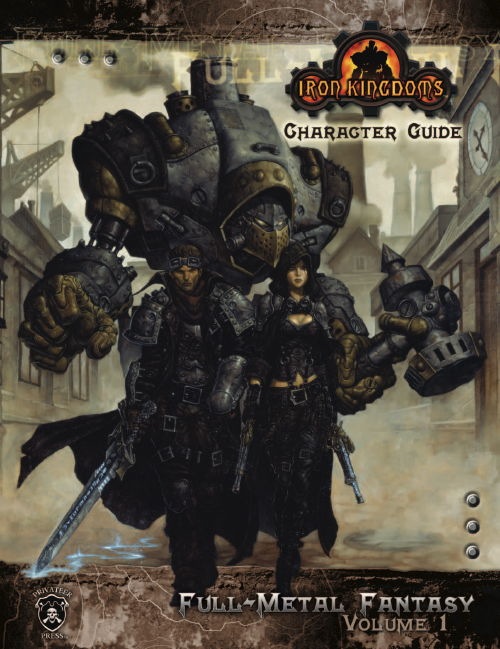
As you can tell from the cover art on the character guide, it attempts to be a blend of medieval fantasy and steampunk, and from what I can tell seems to pull it off fairly well. The concept, or at least the concept art, really appeals to me.
So I went through and pulled the weaponry from it to add to my master list of weapons, including the magical/alchemical firearms. The blasting powder and ammunition for these firearms is enclosed in a silk pouch divided into two compartments. The pin pierces the packet, letting the two magical powders mix, and the resulting explosion follows the path of least resistance down the barrel.
This is all very interesting, and very cool to introduce into a world without firearms. But it occurred to me that if interplanetary travel is possible in one's game, then there would no doubt be access to non-magical firearms, as well as much more advanced weaponry. That opens up a terribly large can of worms, since modern firearms would be (I imagine) much more powerful than even the guns in Iron Kingdoms. Bows and crossbows would fall by the wayside, or be relegated to the poorest of adventurers. The game would no longer be medieval, but instead modern fantasy or even science fiction.
I'm not opposed to those settings, mind you. I grew up with medieval fantasy, so I'm more comfortable there, but I've also played in Cyberpunk. My main concern, here, is what my players are interested in. I don't want to end up adding in more advanced technology, whether it's science or magic based (Any technology sufficiently advanced etc., etc.), and especially if it's to the detriment of the existing weaponry available, if my players would be happier retaining a medieval feel rather than a renaissance, Victorian-era, modern, post-modern apocalyptic, or space cowboy genre.
Since Jonathan provided me with the Iron Kingdoms source material, I can fairly safely assume he's comfortable with a certain level of steampunkery creeping into the game (as well as a necropolis teeming with undead, but that's another story). Knowing my wife, I'm sure she'd be comfortable with a touch of steampunk as well. So I feel mostly safe in adding in the IK weaponry. The full setting, however, doesn't mesh well with the rest of what I've set up. And I really don't want to mess with the clockwork warmachines at this juncture. So I'm still trying to dig for campaign and setting ideas, at least to start off with.
I'd like to be able to roll with any punches the group would throw at me, switch from one world/setting to another, one quest-line to another in midstream without flinching. I remember my mother telling me how she used to set up elaborate campaigns, just to have the party decide, "Nah, let's go that way instead." So now she drops groups in an established safe zone, and lets them choose where to go. Her home-brewed campaign setting, though, encompasses not just worlds, but alternate dimensions. It's large enough that it is still mostly unexplored territory. I end up feeling rather intimidated when trying to choose where to start adventuring.
So I know I need to start off small. Limit my focus to one area, with a handful of low-level campaigns, and build outwards and/or upwards from there. But I want to make sure that, despite it being a small area/low-level, it will grab the interest of my players. To that end...
Anyone have a favorite setting, genre, or concept they'd love to have a chance to play in?
As you can tell from the cover art on the character guide, it attempts to be a blend of medieval fantasy and steampunk, and from what I can tell seems to pull it off fairly well. The concept, or at least the concept art, really appeals to me.
So I went through and pulled the weaponry from it to add to my master list of weapons, including the magical/alchemical firearms. The blasting powder and ammunition for these firearms is enclosed in a silk pouch divided into two compartments. The pin pierces the packet, letting the two magical powders mix, and the resulting explosion follows the path of least resistance down the barrel.
This is all very interesting, and very cool to introduce into a world without firearms. But it occurred to me that if interplanetary travel is possible in one's game, then there would no doubt be access to non-magical firearms, as well as much more advanced weaponry. That opens up a terribly large can of worms, since modern firearms would be (I imagine) much more powerful than even the guns in Iron Kingdoms. Bows and crossbows would fall by the wayside, or be relegated to the poorest of adventurers. The game would no longer be medieval, but instead modern fantasy or even science fiction.
I'm not opposed to those settings, mind you. I grew up with medieval fantasy, so I'm more comfortable there, but I've also played in Cyberpunk. My main concern, here, is what my players are interested in. I don't want to end up adding in more advanced technology, whether it's science or magic based (Any technology sufficiently advanced etc., etc.), and especially if it's to the detriment of the existing weaponry available, if my players would be happier retaining a medieval feel rather than a renaissance, Victorian-era, modern, post-modern apocalyptic, or space cowboy genre.
Since Jonathan provided me with the Iron Kingdoms source material, I can fairly safely assume he's comfortable with a certain level of steampunkery creeping into the game (as well as a necropolis teeming with undead, but that's another story). Knowing my wife, I'm sure she'd be comfortable with a touch of steampunk as well. So I feel mostly safe in adding in the IK weaponry. The full setting, however, doesn't mesh well with the rest of what I've set up. And I really don't want to mess with the clockwork warmachines at this juncture. So I'm still trying to dig for campaign and setting ideas, at least to start off with.
I'd like to be able to roll with any punches the group would throw at me, switch from one world/setting to another, one quest-line to another in midstream without flinching. I remember my mother telling me how she used to set up elaborate campaigns, just to have the party decide, "Nah, let's go that way instead." So now she drops groups in an established safe zone, and lets them choose where to go. Her home-brewed campaign setting, though, encompasses not just worlds, but alternate dimensions. It's large enough that it is still mostly unexplored territory. I end up feeling rather intimidated when trying to choose where to start adventuring.
So I know I need to start off small. Limit my focus to one area, with a handful of low-level campaigns, and build outwards and/or upwards from there. But I want to make sure that, despite it being a small area/low-level, it will grab the interest of my players. To that end...
Anyone have a favorite setting, genre, or concept they'd love to have a chance to play in?
Saturday, July 17, 2010
Intelligence, Classes, and Experience
Multiclassing has faced as well as posed a number of difficulties in D&D. Back in AD&D, the Player's Handbook gave very specific multiclassing options, based upon race. 3rd Edition removed both racial level caps as well as race-based multiclassing, but limited multiclassing through Alignment requirements, as well as arbitrary limitations (Monk and Paladin, I'm looking at you).
After reading through my previous postings, I'm certain most can figure out my thoughts regarding Alignment restrictions on classes. And trying to convince me that you can never gain another level in a certain class because you took one level of something else? No thanks.
The system I grew up on, which had been based out of AD&D, had no multiclassing or alignment restrictions. This worked out just fine for many years, until we ended up with players who started taking four or more classes in order to gain various 1st level benefits and abilities.

Yeah, like that. Only not 1/11th of a class each level, but 11 first level classes all at once.
Our DM decided this was just silly, and so it was ruled that the total number of classes you could have was limited by your character's intelligence. This made sense. Certain classes were considered to be "worth more" than others, like Paladin (because it combined both Fighter and Cleric) and Ranger (Fighter, Druid, and Mage - AD&D, remember). Overall, the system seemed logical and also helped prevent any more Multiclassing Minmaxing. The biggest problem I had with it was the feeling of obligation to "fill up" with the maximum number of classes that the character's Intelligence could support, so as not to waste it.
So over the past few days, I've put together a ruleset on multiclassing for my own system. In this system, your total number of "effective classes" is what determines your experience needed per level. No more taking a class just for one level.
Taking more classes than your Intelligence would allow can be done. Doing so, however, increases the experience needed for each level based upon how many beyond the "maximum" you took, even above what would normally be required just by having the additional classes. As any college student knows, it's much harder to remember everything when you're taking too many classes.
On the other side of the coin, if you take fewer classes than your Intelligence can support, you gain a discount on the experience needed each level, based upon the difference between the number you were allowed and how many you took. You can learn faster, because you're capable of learning more than what is being presented.
On a previous topic, I asked my wife how she viewed magic users in D&D - whether the power was coming from within, being channeled, or simply using ambient energy, or even something completely different. She reminded me of how Steven Brust has things set up in his Jhereg series: Dragaeran sorcery is more or less grabbing available energy and tossing it, while Eastern witchcraft is mentally and physically taxing on the practitioner. And then there's Pre-Empire sorcery. Let's not get into that.
Taking that into consideration, I see a correlation between Brust's witchcraft and Druids, so I would most likely leave Constitution as the power source for them. Equating Dragaeran sorcerers with Mages, however, still doesn't give me a well-defined source of power. The Dragaerans pull energy through their link with an artifact-level magic item, which basically gives them an inexhaustible supply of mana. I can't really have that.
I've tinkered with a number of options: Base mana off of Cunning, to represent craftiness through the handling and redistribution of ambient mana. Base it off of Perception, to represent the ability to see or notice the surrounding power in order to use it. Base it off of Luck, to represent the idea that ambient power levels can vary from location to location. I've even considered the option of reworking Shadowrun's system of magic, where spells don't take mana, but instead have a chance of draining you when you cast one. Fail too many "Drain" checks, and you're unconscious. Trying to balance that in a d20 system, though, would take a great deal more work than I'm willing to expend on just this one aspect right now, and still leaves Mages with a potentially inexhaustible supply of power.
I briefly considered making each Mage subclass (Illusionist, Transmuter, Evoker, etc.) have a different stat that it uses for power, but I think that would just make things far too complicated and confusing. And it still wouldn't answer what stat to have Mages use. At this point, I'm tempted to either stick with Constitution, or assign it to Perception, the latter mainly because I don't have a lot tied to that stat yet.
Suggestions?
After reading through my previous postings, I'm certain most can figure out my thoughts regarding Alignment restrictions on classes. And trying to convince me that you can never gain another level in a certain class because you took one level of something else? No thanks.
The system I grew up on, which had been based out of AD&D, had no multiclassing or alignment restrictions. This worked out just fine for many years, until we ended up with players who started taking four or more classes in order to gain various 1st level benefits and abilities.

Yeah, like that. Only not 1/11th of a class each level, but 11 first level classes all at once.
Our DM decided this was just silly, and so it was ruled that the total number of classes you could have was limited by your character's intelligence. This made sense. Certain classes were considered to be "worth more" than others, like Paladin (because it combined both Fighter and Cleric) and Ranger (Fighter, Druid, and Mage - AD&D, remember). Overall, the system seemed logical and also helped prevent any more Multiclassing Minmaxing. The biggest problem I had with it was the feeling of obligation to "fill up" with the maximum number of classes that the character's Intelligence could support, so as not to waste it.
So over the past few days, I've put together a ruleset on multiclassing for my own system. In this system, your total number of "effective classes" is what determines your experience needed per level. No more taking a class just for one level.
Taking more classes than your Intelligence would allow can be done. Doing so, however, increases the experience needed for each level based upon how many beyond the "maximum" you took, even above what would normally be required just by having the additional classes. As any college student knows, it's much harder to remember everything when you're taking too many classes.
On the other side of the coin, if you take fewer classes than your Intelligence can support, you gain a discount on the experience needed each level, based upon the difference between the number you were allowed and how many you took. You can learn faster, because you're capable of learning more than what is being presented.
On a previous topic, I asked my wife how she viewed magic users in D&D - whether the power was coming from within, being channeled, or simply using ambient energy, or even something completely different. She reminded me of how Steven Brust has things set up in his Jhereg series: Dragaeran sorcery is more or less grabbing available energy and tossing it, while Eastern witchcraft is mentally and physically taxing on the practitioner. And then there's Pre-Empire sorcery. Let's not get into that.
Taking that into consideration, I see a correlation between Brust's witchcraft and Druids, so I would most likely leave Constitution as the power source for them. Equating Dragaeran sorcerers with Mages, however, still doesn't give me a well-defined source of power. The Dragaerans pull energy through their link with an artifact-level magic item, which basically gives them an inexhaustible supply of mana. I can't really have that.
I've tinkered with a number of options: Base mana off of Cunning, to represent craftiness through the handling and redistribution of ambient mana. Base it off of Perception, to represent the ability to see or notice the surrounding power in order to use it. Base it off of Luck, to represent the idea that ambient power levels can vary from location to location. I've even considered the option of reworking Shadowrun's system of magic, where spells don't take mana, but instead have a chance of draining you when you cast one. Fail too many "Drain" checks, and you're unconscious. Trying to balance that in a d20 system, though, would take a great deal more work than I'm willing to expend on just this one aspect right now, and still leaves Mages with a potentially inexhaustible supply of power.
I briefly considered making each Mage subclass (Illusionist, Transmuter, Evoker, etc.) have a different stat that it uses for power, but I think that would just make things far too complicated and confusing. And it still wouldn't answer what stat to have Mages use. At this point, I'm tempted to either stick with Constitution, or assign it to Perception, the latter mainly because I don't have a lot tied to that stat yet.
Suggestions?
Sunday, July 4, 2010
Confessions of a Gamer Parent
I love my son. He is intelligent, curious, creative, and adorable. He is frequently well-behaved, despite being in the "Terrible Twos" range. As much as he may frustrate me at times, I am deeply proud of him and am, daily, glad of the fact that he is in my life. I would not give him up for anything...
But I would appreciate the option of paying someone to watch him for a few hours, maybe twice a month.
At present, that's just not an option for financial reasons. Even when I do have some spare cash, though, I simply do not know any babysitters in our area. The nearest relatives are an hour away, and have enough physical difficulties that it would be, at best, hard on them to keep up with a toddler.
This comes about because: for the past couple of months I have been making the 1.5-2 hour drive, every other week, to play Shadowrun with the old Tuesday Group(tm). But as much as I enjoy seeing the guys, and getting out for a game, this is just not a sustainable situation for a few reasons.
1) Again, money: Gasoline is not cheap. Purchasing nothing else, a round trip costs about $13. That may not sound like much, but seeing as how my current job is giving me no work, has not given any work for about two weeks, and doesn't expect to have any additional work until the middle of the month, I'm counting every penny.
2) Time: The game goes from 7pm to 10pm - three hours. Often, I'll end up spending another hour just talking with my friends, reviewing the game, making plans for the next one, etc. But the game itself is three hours, which means I'm spending at least as much time on the road as I am at the table. This also means I'm leaving home at around 5pm and not returning until midnight or later.
3) Fairness to my wife: She's been wonderful and sweet, and was the one who insisted I start going to the games, but there is no equal and opposite reaction here. I go off and have fun in tabletop gaming, leaving her to watch our son. She does not have a group of friends to go hang out and game with for hours at a time, and so I have no way to reciprocate the favor.
Ideally, we'd love to find a local gaming group that both of us can participate in together. I actually do know of a couple of people in the area who are gamers, and would most likely welcome us to the table.
But our son, as bright and talented as he is, is still a toddler. He is not going to sit still on a lap for several hours while Mommy and Daddy are bashing goblins. While he is getting close to the point where he might enjoy similar pursuits, he most likely will not have the attention span to maintain that interest for an extended period of time. For the moment, then, unless we game in our own home (and oftentimes even then) we will expend more time and energy trying to wrangle with him than with monsters.
The experience has given me a new appreciation for what my parents must have gone through while raising me, and adds a new perspective to the memories I have of their tabletop games during my early years. I could argue that they had an advantage in the fact that my mother was frequently the DM, since I imagine a lot of players would be more willing to put up with having a kid around (alternately wanting to play, seeking attention, making noise, and then running off when focus is lost only to return five minutes later wanting to play the game again) if it meant that they didn't have to run a game themselves, and the DM is generally more forgiving of having the game they've put together interrupted when the disturbance is caused by their own child. Still, I imagine they may have lost some players, or simply had fewer of them, due to my presence. And I'm certain I kept them from playing as often as they may have liked.
Maybe I'll see about trying to run a local game myself. I've been working on a system, and looking for opportunities to playtest it, but I've currently got absolutely zilch as far as campaign ideas go. I'd also have to overcome my anxiety of inviting strangers into my house, since there really isn't any local gathering place I'm aware of that would look too kindly on playing D&D, no matter what version or variant. And, of course, there's the cleaning to do.
*glances around*
Maybe we could try the local Hardees instead. They ARE open 24 hours...
But I would appreciate the option of paying someone to watch him for a few hours, maybe twice a month.
At present, that's just not an option for financial reasons. Even when I do have some spare cash, though, I simply do not know any babysitters in our area. The nearest relatives are an hour away, and have enough physical difficulties that it would be, at best, hard on them to keep up with a toddler.
This comes about because: for the past couple of months I have been making the 1.5-2 hour drive, every other week, to play Shadowrun with the old Tuesday Group(tm). But as much as I enjoy seeing the guys, and getting out for a game, this is just not a sustainable situation for a few reasons.
1) Again, money: Gasoline is not cheap. Purchasing nothing else, a round trip costs about $13. That may not sound like much, but seeing as how my current job is giving me no work, has not given any work for about two weeks, and doesn't expect to have any additional work until the middle of the month, I'm counting every penny.
2) Time: The game goes from 7pm to 10pm - three hours. Often, I'll end up spending another hour just talking with my friends, reviewing the game, making plans for the next one, etc. But the game itself is three hours, which means I'm spending at least as much time on the road as I am at the table. This also means I'm leaving home at around 5pm and not returning until midnight or later.
3) Fairness to my wife: She's been wonderful and sweet, and was the one who insisted I start going to the games, but there is no equal and opposite reaction here. I go off and have fun in tabletop gaming, leaving her to watch our son. She does not have a group of friends to go hang out and game with for hours at a time, and so I have no way to reciprocate the favor.
Ideally, we'd love to find a local gaming group that both of us can participate in together. I actually do know of a couple of people in the area who are gamers, and would most likely welcome us to the table.
But our son, as bright and talented as he is, is still a toddler. He is not going to sit still on a lap for several hours while Mommy and Daddy are bashing goblins. While he is getting close to the point where he might enjoy similar pursuits, he most likely will not have the attention span to maintain that interest for an extended period of time. For the moment, then, unless we game in our own home (and oftentimes even then) we will expend more time and energy trying to wrangle with him than with monsters.
The experience has given me a new appreciation for what my parents must have gone through while raising me, and adds a new perspective to the memories I have of their tabletop games during my early years. I could argue that they had an advantage in the fact that my mother was frequently the DM, since I imagine a lot of players would be more willing to put up with having a kid around (alternately wanting to play, seeking attention, making noise, and then running off when focus is lost only to return five minutes later wanting to play the game again) if it meant that they didn't have to run a game themselves, and the DM is generally more forgiving of having the game they've put together interrupted when the disturbance is caused by their own child. Still, I imagine they may have lost some players, or simply had fewer of them, due to my presence. And I'm certain I kept them from playing as often as they may have liked.
Maybe I'll see about trying to run a local game myself. I've been working on a system, and looking for opportunities to playtest it, but I've currently got absolutely zilch as far as campaign ideas go. I'd also have to overcome my anxiety of inviting strangers into my house, since there really isn't any local gathering place I'm aware of that would look too kindly on playing D&D, no matter what version or variant. And, of course, there's the cleaning to do.
*glances around*
Maybe we could try the local Hardees instead. They ARE open 24 hours...
Tuesday, June 17, 2008
Games are (supposed to be) fun
As games of all sorts have advanced, they've also gotten more complicated. There's more to remember, more to do, different tactics or combinations to learn. Some recent video games I've seen have tried to revert to a simpler layout, or to make things more intuitive for the player, but that only makes things more complicated for the programmers, not to mention the fact that what's intuitive for one person may be completely foreign to someone else. And, of course, what's intuitive anymore? Now that we've all become so used to the non-intuitiveness of previous video games, have they replaced our instinctual coordination?
As they've advanced, there's also been a bigger push for video games that allow you to play with other people. But we've gone beyond adding a second controller, or taking turns to see who can get the better score. We have to all play at the same time, and be able to cooperate with (or attack) each other. But we don't always have access to a circle of friends that can come over and play with the console, now that we've bought the eight controller adapter and six extra controllers, not to mention the money to invest in all that hardware to begin with. So we've acquiesced to the fate of the friendless or isolated, and play online with strangers we've never met in the hopes they won't make us feel too inferior.
I have a wonderful new computer, thanks to my darling and beautiful wife. It was a birthday present this year. However, there's not much either of us can do about our internet connection, and if the baby knows what to do, he's not talking. We live just outside the city limits, so we don't have access to the cable or DSL the city provides. There's a DSL extension which would reach us, but it's full, and has been for a year with no expectation of vacancy. So we have two options: dial-up or satellite. I almost wonder if we should have stuck with dial-up. We're supposed to have 1MB/s download speeds, but we're lucky if we reach a tenth of that. Which makes online gaming rather lag-filled at best.
Despite this, we do our best to enjoy the games we play. Both my wife and I were avid game players before we got together, and that isn't likely to change. We've done City of Heroes/Villians, Neverwinter Nights, Age of Mythology/Empires, and a number of free MMO(RP?)Gs including Flyff, Runescape, and most recently Mabinogi.
It can be something of a hardship, at times, to play. I can see other characters perform skills at speeds that were engineered to astound, while I move in relative slow-motion. Others can shoot their arrows three times or more before I can manage one shot. Magical skills are another difficulty. The ice bolt skill, for example, allows you to shoot five bolts in rapid succession. I can maybe get in two shots before the enemy has reached and hit me. The healing skill, another rapid succession spell, I can heal once, maybe twice, before another character has expended all their charges. The majority of tactics which are in common practice with the playerbase are impossible for my wife and I to use, simply because our connection speed is too slow, something which we try to explain (with varying levels of success) to those we group with, so as not to have them think we're not trying to pull our own weight.
Sometimes, frustration over our plight builds, usually in me, and I become more stressed by playing the game, something which was intended as a means of releasing tension and having fun, than I would have by, say, reflooring our living room (not an arbitrary comparison, as I have very recent experience to draw from). Yet I continue to play. Am I drawn by the fun that I'm having despite the poor connection? By the fun that can potentially exist in the game, if things were going as they should? Or am I just a sucker for the shiny graphics?
Then I come across someone, in-game, who spends the better part of an hour complaining about how bored they are, and asking if someone can come revive their character, because they don't want to respawn back at the last town and have to walk all the way back. They ended up, eventually, taking a greater hit to their experience points by reviving on-the-spot, rather than having to make the trek across... two screen transitions? And they're still bored.
If you're bored with the game, it obviously isn't fulfilling its purpose, and you should stop playing. I might get frustrated, but at least I'm never bored.
As they've advanced, there's also been a bigger push for video games that allow you to play with other people. But we've gone beyond adding a second controller, or taking turns to see who can get the better score. We have to all play at the same time, and be able to cooperate with (or attack) each other. But we don't always have access to a circle of friends that can come over and play with the console, now that we've bought the eight controller adapter and six extra controllers, not to mention the money to invest in all that hardware to begin with. So we've acquiesced to the fate of the friendless or isolated, and play online with strangers we've never met in the hopes they won't make us feel too inferior.
I have a wonderful new computer, thanks to my darling and beautiful wife. It was a birthday present this year. However, there's not much either of us can do about our internet connection, and if the baby knows what to do, he's not talking. We live just outside the city limits, so we don't have access to the cable or DSL the city provides. There's a DSL extension which would reach us, but it's full, and has been for a year with no expectation of vacancy. So we have two options: dial-up or satellite. I almost wonder if we should have stuck with dial-up. We're supposed to have 1MB/s download speeds, but we're lucky if we reach a tenth of that. Which makes online gaming rather lag-filled at best.
Despite this, we do our best to enjoy the games we play. Both my wife and I were avid game players before we got together, and that isn't likely to change. We've done City of Heroes/Villians, Neverwinter Nights, Age of Mythology/Empires, and a number of free MMO(RP?)Gs including Flyff, Runescape, and most recently Mabinogi.
It can be something of a hardship, at times, to play. I can see other characters perform skills at speeds that were engineered to astound, while I move in relative slow-motion. Others can shoot their arrows three times or more before I can manage one shot. Magical skills are another difficulty. The ice bolt skill, for example, allows you to shoot five bolts in rapid succession. I can maybe get in two shots before the enemy has reached and hit me. The healing skill, another rapid succession spell, I can heal once, maybe twice, before another character has expended all their charges. The majority of tactics which are in common practice with the playerbase are impossible for my wife and I to use, simply because our connection speed is too slow, something which we try to explain (with varying levels of success) to those we group with, so as not to have them think we're not trying to pull our own weight.
Sometimes, frustration over our plight builds, usually in me, and I become more stressed by playing the game, something which was intended as a means of releasing tension and having fun, than I would have by, say, reflooring our living room (not an arbitrary comparison, as I have very recent experience to draw from). Yet I continue to play. Am I drawn by the fun that I'm having despite the poor connection? By the fun that can potentially exist in the game, if things were going as they should? Or am I just a sucker for the shiny graphics?
Then I come across someone, in-game, who spends the better part of an hour complaining about how bored they are, and asking if someone can come revive their character, because they don't want to respawn back at the last town and have to walk all the way back. They ended up, eventually, taking a greater hit to their experience points by reviving on-the-spot, rather than having to make the trek across... two screen transitions? And they're still bored.
If you're bored with the game, it obviously isn't fulfilling its purpose, and you should stop playing. I might get frustrated, but at least I'm never bored.
Subscribe to:
Posts (Atom)