In reconsidering a skill system, I'd come across the fact that I don't have a lot tied to the Cunning stat, and so was considering whether it should be kept. It plays a part in Psionics, and I had previously set it to determine how many fighting skills a Fighter would get per level. After some review, and re-reading the dictionary definition, I'm not sure the latter use is appropriate.
Cunning is this strange conglomeration, made up of aspects of the other mental attributes: Intelligence, Wisdom, and Charisma. Bluffing or conning someone, or feinting in combat are good examples of using Cunning. Seducing someone could be Cunning mixed with Charisma, as would (potentially) disguising yourself or acting out a role. A master tactician would be intelligent (having learned about tactics and studied them in history), wise (know your enemy, know yourself), and also cunning (applying strategies in unpredictable ways, developing new techniques). Cunning seems to be concerned with the application of these other abilities (Int, Wis, Cha) in base, predatory ways, while preventing others from knowing what you're up to.
Despite the closely-tied nature of these stats, though, it's obvious that a highly developed Cunning can exist even without Intelligence, Wisdom, or Charisma. Goblins and Bugbears are frequently considered cunning, despite not being the brightest or most beautiful. Captain Jack Sparrow showed a great deal of cunning, and had some Charisma to back it up, but was not portrayed as the most wise or intelligent individual.
As a character stat, it's difficult to pin down what exactly Cunning should (or should not) affect. I considered the option of having Cunning directly affect the amount of extra damage dealt by a Sneak Attack, but one of my players expressed the opinion that the ability to strike vulnerable areas is a learned skill and should therefore be improvable. I could make another Combat Proficiency which would allow for that.
My wife mentioned the possibility of Cunning as a skill, rather than a stat, making the argument that one's shrewdness and guile could be practiced and improved. The question there would be, though, what would Cunning, as a skill, do? Most of what we came up with would cause it to affect other skills, rather than do something on its own like the other skills.
Still exploring possibilities with this.
Wednesday, September 8, 2010

Sunday, September 5, 2010
Skills in 3rd Edition
While the skills system (intended as an improvement over the non-weapon proficiencies and non-combat class skills from earlier versions) can be handy, it can also be cumbersome. Feat and skill selection are the two most time-consuming aspects of character creation in 3rd edition, especially for a new player who isn't familiar with what feats are available, or doesn't know what certain skills do or their importance.
The biggest bonus of having a skill system, rather than basing all skill checks off of stat checks, is that it allows the character to improve based upon what they want to train. The system, as presented in 3rd Ed., reflects the idea that training, rather than natural talent, is the key to success when it comes to any given ability. Climbing, for example, is based on Strength. A strong character will have a minor advantage over an average-strength character, given equal ranks in the Climb skill. If the strong character hasn't put any skill points into Climb, though, and the average one has maxed his ranks, then the average character will probably climb better starting at level one, and will continue getting better each level.
This system doesn't make as much sense for some skills, and at some point it becomes rather difficult to suspend disbelief since there is no cap to how high a skill can be improved. My biggest issue, though, is that skill points are not based directly off of Intelligence. A high Int helps, but your base skill points are determined by your class. This was another way WotC tried to establish a "balance" between the classes, or just perpetuate stereotypes. Rogues get the most skill points, with bards coming in next. Wizards and Clerics hardly get any, though the high Intelligence most Wizards have helps to off-set this.
Different classes have their access to certain skills restricted, by means of making certain skills class related ("class skills") or non-class related ("cross-class skills"). Of course, these are based on your class, with Rogues, again, having most skills as class skills, and clerics and wizards receiving very few class skills. Cross-class skills require double the skill points to improve, so despite the boost to points that a high Int gives wizards, they still don't manage to go very far. I suppose the idea is that all the time studying spells or worshiping a deity doesn't allow for much in the way of hobbies, but again it seems arbitrary in a non-logical way.
Distributing skill points is a pain. But the other option is making skills based off of a stat check. Want to climb something? Roll the dice, and hope the total is less than your Strength. Simple, but it leaves little room for improvement. It might not be as important to improve things like Climbing, but you want your rogue to be able to pick any lock or disarm any trap the party comes across. As things progress, harder and harder challenges will come along, but if a thief is no better at doing thief-y things by 5th level than he was at 1st, what was the point of being a thief?
I like the concept that any given character, regardless of class, might be good at a particular skill: a fighter who is an expert in sleight of hand, a cleric who knows how to pick a lock, a wizard who is also an accomplished songwriter. The class at risk of losing the most, in such a system, is the thief or rogue: If anyone can pick a lock or disarm a trap, why even have a thief class?
So there needs to be a way of improving things. Do I mandate which skills improve, or do I find a way to allot points to be distributed by the player? If it's player distributed, you might still end up with a wizard who's as good or better than a thief at the iconic tasks. The main difference, I suppose, would be the combat training. A thief gets to backstab/sneak attack, and has some other minor combat abilities, while the mage has spells to sling.
The biggest bonus of having a skill system, rather than basing all skill checks off of stat checks, is that it allows the character to improve based upon what they want to train. The system, as presented in 3rd Ed., reflects the idea that training, rather than natural talent, is the key to success when it comes to any given ability. Climbing, for example, is based on Strength. A strong character will have a minor advantage over an average-strength character, given equal ranks in the Climb skill. If the strong character hasn't put any skill points into Climb, though, and the average one has maxed his ranks, then the average character will probably climb better starting at level one, and will continue getting better each level.
This system doesn't make as much sense for some skills, and at some point it becomes rather difficult to suspend disbelief since there is no cap to how high a skill can be improved. My biggest issue, though, is that skill points are not based directly off of Intelligence. A high Int helps, but your base skill points are determined by your class. This was another way WotC tried to establish a "balance" between the classes, or just perpetuate stereotypes. Rogues get the most skill points, with bards coming in next. Wizards and Clerics hardly get any, though the high Intelligence most Wizards have helps to off-set this.
Different classes have their access to certain skills restricted, by means of making certain skills class related ("class skills") or non-class related ("cross-class skills"). Of course, these are based on your class, with Rogues, again, having most skills as class skills, and clerics and wizards receiving very few class skills. Cross-class skills require double the skill points to improve, so despite the boost to points that a high Int gives wizards, they still don't manage to go very far. I suppose the idea is that all the time studying spells or worshiping a deity doesn't allow for much in the way of hobbies, but again it seems arbitrary in a non-logical way.
Distributing skill points is a pain. But the other option is making skills based off of a stat check. Want to climb something? Roll the dice, and hope the total is less than your Strength. Simple, but it leaves little room for improvement. It might not be as important to improve things like Climbing, but you want your rogue to be able to pick any lock or disarm any trap the party comes across. As things progress, harder and harder challenges will come along, but if a thief is no better at doing thief-y things by 5th level than he was at 1st, what was the point of being a thief?
I like the concept that any given character, regardless of class, might be good at a particular skill: a fighter who is an expert in sleight of hand, a cleric who knows how to pick a lock, a wizard who is also an accomplished songwriter. The class at risk of losing the most, in such a system, is the thief or rogue: If anyone can pick a lock or disarm a trap, why even have a thief class?
So there needs to be a way of improving things. Do I mandate which skills improve, or do I find a way to allot points to be distributed by the player? If it's player distributed, you might still end up with a wizard who's as good or better than a thief at the iconic tasks. The main difference, I suppose, would be the combat training. A thief gets to backstab/sneak attack, and has some other minor combat abilities, while the mage has spells to sling.
Wednesday, September 1, 2010
DDO: Monks and Bards
I discovered something the other night, logging in to DDO. Despite my love for bards and monks, I've actually found they're two of the most stressful/difficult classes to play. I think I've managed to narrow down why.
In DDO, monks get a lot of nifty, customized abilities that weren't part of 3rd edition. It adds some flavor and flash, and there's some talk about them being overpowered, which of course makes them desired by anyone who wants to be unbeatable. I have to admit that they can be very lethal in dealing out massive amounts of damage, and pretty quickly. In that regard, they're on par with a dual-wielding rogue with sneak attack. Yet fighters and rogues both have ways of dealing with the aggro that comes from dealing massive damage: fighters have more HP, and can wear shields to increase damage reduction, while rogues have an enhancement ability that decreases the aggro (or "hate" as it's called in-game) that their sneak attacks produce. Perhaps a Constitution-heavy monk would be better at taking the hits, but they'd also be less adept at giving them. Some of the monk abilities can reproduce a few beneficial (but at low to mid-level relatively unused) clerical spells, like removing blindness or curing diseases, but overall I end up feeling like I should multiclass into rogue or cleric so I can be more useful.
Bards are another issue, one that extends beyond just DDO. Jack-of-all-trades, master of none, yes, I get it. They're supposed to be able to make up for an existing lack in party balance, tossing in whatever low to mid-level magic is necessary that the cleric and wizard are too busy to cast. Plus they get the bard songs. But the bonus the party gets from the songs is minimal, and in many cases is easily replaced by spells from other classes, and you'd be hard pressed to find a party that wouldn't rather have a second cleric than a bard. Because the bard's role is so varied, you either end up wasting time trying to figure out what your role in this party needs to be, or you end up being told what you should be doing which may or may not correlate with the skills and spells you've taken as a bard. Regardless, more often than not you end up feeling superfluous or just plain weak.
More than clerics, I think bards have a significant in-game and balance reason for needing the ability to switch spells on a daily (or in DDO, per-rest) basis. It wouldn't really help their survivability, but it would let them tailor their abilities to each party a bit better, much like a wizard or cleric can. As it is, in DDO they can change one spell every 3 real-life days, and pay in-game currency for the privilege.
The rules for bard and sorcerer spells were based on a system in which the character would be played with (generally speaking) a single group. It didn't account for having five different parties in a single day, and having to re-figure your character's role in each of them.
In DDO, monks get a lot of nifty, customized abilities that weren't part of 3rd edition. It adds some flavor and flash, and there's some talk about them being overpowered, which of course makes them desired by anyone who wants to be unbeatable. I have to admit that they can be very lethal in dealing out massive amounts of damage, and pretty quickly. In that regard, they're on par with a dual-wielding rogue with sneak attack. Yet fighters and rogues both have ways of dealing with the aggro that comes from dealing massive damage: fighters have more HP, and can wear shields to increase damage reduction, while rogues have an enhancement ability that decreases the aggro (or "hate" as it's called in-game) that their sneak attacks produce. Perhaps a Constitution-heavy monk would be better at taking the hits, but they'd also be less adept at giving them. Some of the monk abilities can reproduce a few beneficial (but at low to mid-level relatively unused) clerical spells, like removing blindness or curing diseases, but overall I end up feeling like I should multiclass into rogue or cleric so I can be more useful.
Bards are another issue, one that extends beyond just DDO. Jack-of-all-trades, master of none, yes, I get it. They're supposed to be able to make up for an existing lack in party balance, tossing in whatever low to mid-level magic is necessary that the cleric and wizard are too busy to cast. Plus they get the bard songs. But the bonus the party gets from the songs is minimal, and in many cases is easily replaced by spells from other classes, and you'd be hard pressed to find a party that wouldn't rather have a second cleric than a bard. Because the bard's role is so varied, you either end up wasting time trying to figure out what your role in this party needs to be, or you end up being told what you should be doing which may or may not correlate with the skills and spells you've taken as a bard. Regardless, more often than not you end up feeling superfluous or just plain weak.
More than clerics, I think bards have a significant in-game and balance reason for needing the ability to switch spells on a daily (or in DDO, per-rest) basis. It wouldn't really help their survivability, but it would let them tailor their abilities to each party a bit better, much like a wizard or cleric can. As it is, in DDO they can change one spell every 3 real-life days, and pay in-game currency for the privilege.
The rules for bard and sorcerer spells were based on a system in which the character would be played with (generally speaking) a single group. It didn't account for having five different parties in a single day, and having to re-figure your character's role in each of them.
Tuesday, August 17, 2010
New Source Material
My friend Jonathan just recently visited again (yay!) and brought with him some books he picked up really cheap from his local gaming store. Three were from the same setting, called Arcanis, which is apparently now out-of-print but had been a 3rd Edition compatible campaign world. Not nearly as publicized as Forgotten Realms or Eberron, Arcanis has actually struck me as more interesting, and definitely more varied in its magic.
I've been reading through the material as I can, between doing reading and other assignments for college. Though online, they are accelerated courses, so it can still be a struggle to keep on top of things. I've pondered the option of cross-posting my written assignments here, so others can see what I'm working on, but I'd hate to have a professor do an internet search and believe I had plagiarized. It would be easy enough to prove that I hadn't, I guess, but I'm not sure I want to take the chance even so.
I've been reading through the material as I can, between doing reading and other assignments for college. Though online, they are accelerated courses, so it can still be a struggle to keep on top of things. I've pondered the option of cross-posting my written assignments here, so others can see what I'm working on, but I'd hate to have a professor do an internet search and believe I had plagiarized. It would be easy enough to prove that I hadn't, I guess, but I'm not sure I want to take the chance even so.
Monday, August 2, 2010
Experience Points and Level Ranks
In the MMORPG Dungeons and Dragons Online, the experience points required to level were altered (increased) from the 3rd edition rules that the game is based on. This was a good move for them, because an online game isn't limited to how often a group of people can gather around a single table, and the internet has already seen how singularly dedicated people can be to level-grind in games. If it used the original table, either the rewards given for quests would need to be seriously reduced, or people would face no real challenge in getting to the current maximum level of 20.
To give an idea of the difference between the two experience tables, the original 3rd Edition requires 190,000 experience to get to 20th level. DDO requires 1.9 million, ten times as much.
Even in an online setting, however, this amount of experience between levels can be daunting, so DDO breaks each level up into five ranks. Each rank you achieve (that isn't a level-up) gives you one enhancement point, to be used to purchase minor abilities and provide a way to further customize your character's skillset. I think that some of these abilities are pretty neat, and will probably be looking for a way to incorporate some of this into my game.
I don't think adopting their experience chart is the right path for me to go, however, since live games are few and far enough between already. I'm all for making each level gained feel like an epic accomplishment, but I think I'd end up discouraging people. So if I want to add this, I'd need to figure out some other way of distributing ranks or enhancement points.
To give an idea of the difference between the two experience tables, the original 3rd Edition requires 190,000 experience to get to 20th level. DDO requires 1.9 million, ten times as much.
Even in an online setting, however, this amount of experience between levels can be daunting, so DDO breaks each level up into five ranks. Each rank you achieve (that isn't a level-up) gives you one enhancement point, to be used to purchase minor abilities and provide a way to further customize your character's skillset. I think that some of these abilities are pretty neat, and will probably be looking for a way to incorporate some of this into my game.
I don't think adopting their experience chart is the right path for me to go, however, since live games are few and far enough between already. I'm all for making each level gained feel like an epic accomplishment, but I think I'd end up discouraging people. So if I want to add this, I'd need to figure out some other way of distributing ranks or enhancement points.
Sunday, July 25, 2010
Inspiration Gathering
My wife and I took our son to the library last week, and while we were there I did a bit of hunting through their shelves, trying to find some inspiration for settings and such. I discovered a few books by Margaret Weis of Dragonlance fame, though not a full set of anything. They didn't have any of Salvatore's work, either, which surprised me a bit considering his popularity.
We had arrived late, and the library was closing soon, so I didn't get a lot of time to look through things. I more or less picked this up at random:

It looked to be a blend of science fiction and fantasy, incorporating both magic and space travel. It seems to be the second in a set, possibly a trilogy, so I was a little disappointed that I hadn't been able to borrow the first, but it was easy enough to follow regardless.
Having read it, I've now settled on using Perception for Mage mana. I also have a rather nifty reason for why someone can't just take a firearm from Earth and go on a planet-hopping rampage with it. Essentially, the universe is separated into different zones, each with a different reality. Each reality has its own rules regarding physics and magic. Spaceships are built with the ability to reconfigure the way they work, in order to align themselves with the laws of each reality they pass through. If they didn't reconfigure, they would be incapable of moving past the boundary.
In the book, the closer you get to the center of the universe, the less distance there is between realities. Ships that travel near the center have to be extremely flexible to change their configurations quickly. Their crews carry swords, rather than energy weapons, guns, etc., because a sharp blade is always a sharp blade, regardless of reality.
Those who use magic must learn to manipulate the mana according to the rules of the reality they are in. They need to be able to sense the flow of mana, so that they can figure out how it is used in their current location.
While I may not be ready for an interplanetary campaign, I at least have some ideas for how I might do it, as well as some additional things to keep in mind when I come up with new worlds to explore.
We had arrived late, and the library was closing soon, so I didn't get a lot of time to look through things. I more or less picked this up at random:

It looked to be a blend of science fiction and fantasy, incorporating both magic and space travel. It seems to be the second in a set, possibly a trilogy, so I was a little disappointed that I hadn't been able to borrow the first, but it was easy enough to follow regardless.
Having read it, I've now settled on using Perception for Mage mana. I also have a rather nifty reason for why someone can't just take a firearm from Earth and go on a planet-hopping rampage with it. Essentially, the universe is separated into different zones, each with a different reality. Each reality has its own rules regarding physics and magic. Spaceships are built with the ability to reconfigure the way they work, in order to align themselves with the laws of each reality they pass through. If they didn't reconfigure, they would be incapable of moving past the boundary.
In the book, the closer you get to the center of the universe, the less distance there is between realities. Ships that travel near the center have to be extremely flexible to change their configurations quickly. Their crews carry swords, rather than energy weapons, guns, etc., because a sharp blade is always a sharp blade, regardless of reality.
Those who use magic must learn to manipulate the mana according to the rules of the reality they are in. They need to be able to sense the flow of mana, so that they can figure out how it is used in their current location.
While I may not be ready for an interplanetary campaign, I at least have some ideas for how I might do it, as well as some additional things to keep in mind when I come up with new worlds to explore.
Monday, July 19, 2010
Settings and Genres
Though I've been focused mostly on mechanics, I've also been keeping my eyes open for campaign settings and other tidbits that I hope would make the game more interesting for everyone. My friend Jonathan does his best to keep me supplied with new material to sift through, and loaned me a book based in a setting called the Iron Kingdoms.
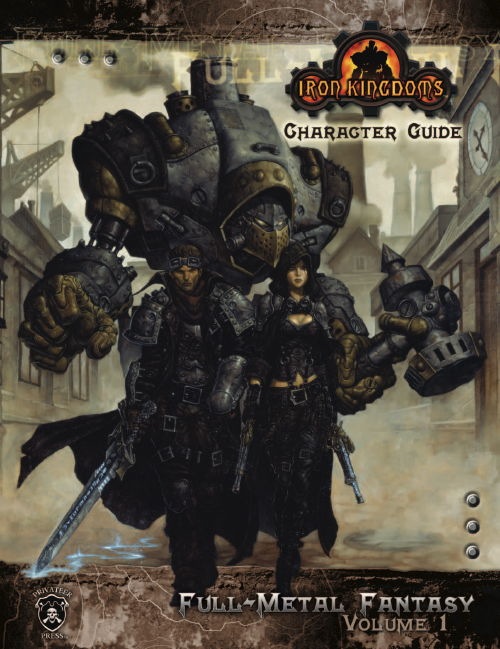
As you can tell from the cover art on the character guide, it attempts to be a blend of medieval fantasy and steampunk, and from what I can tell seems to pull it off fairly well. The concept, or at least the concept art, really appeals to me.
So I went through and pulled the weaponry from it to add to my master list of weapons, including the magical/alchemical firearms. The blasting powder and ammunition for these firearms is enclosed in a silk pouch divided into two compartments. The pin pierces the packet, letting the two magical powders mix, and the resulting explosion follows the path of least resistance down the barrel.
This is all very interesting, and very cool to introduce into a world without firearms. But it occurred to me that if interplanetary travel is possible in one's game, then there would no doubt be access to non-magical firearms, as well as much more advanced weaponry. That opens up a terribly large can of worms, since modern firearms would be (I imagine) much more powerful than even the guns in Iron Kingdoms. Bows and crossbows would fall by the wayside, or be relegated to the poorest of adventurers. The game would no longer be medieval, but instead modern fantasy or even science fiction.
I'm not opposed to those settings, mind you. I grew up with medieval fantasy, so I'm more comfortable there, but I've also played in Cyberpunk. My main concern, here, is what my players are interested in. I don't want to end up adding in more advanced technology, whether it's science or magic based (Any technology sufficiently advanced etc., etc.), and especially if it's to the detriment of the existing weaponry available, if my players would be happier retaining a medieval feel rather than a renaissance, Victorian-era, modern, post-modern apocalyptic, or space cowboy genre.
Since Jonathan provided me with the Iron Kingdoms source material, I can fairly safely assume he's comfortable with a certain level of steampunkery creeping into the game (as well as a necropolis teeming with undead, but that's another story). Knowing my wife, I'm sure she'd be comfortable with a touch of steampunk as well. So I feel mostly safe in adding in the IK weaponry. The full setting, however, doesn't mesh well with the rest of what I've set up. And I really don't want to mess with the clockwork warmachines at this juncture. So I'm still trying to dig for campaign and setting ideas, at least to start off with.
I'd like to be able to roll with any punches the group would throw at me, switch from one world/setting to another, one quest-line to another in midstream without flinching. I remember my mother telling me how she used to set up elaborate campaigns, just to have the party decide, "Nah, let's go that way instead." So now she drops groups in an established safe zone, and lets them choose where to go. Her home-brewed campaign setting, though, encompasses not just worlds, but alternate dimensions. It's large enough that it is still mostly unexplored territory. I end up feeling rather intimidated when trying to choose where to start adventuring.
So I know I need to start off small. Limit my focus to one area, with a handful of low-level campaigns, and build outwards and/or upwards from there. But I want to make sure that, despite it being a small area/low-level, it will grab the interest of my players. To that end...
Anyone have a favorite setting, genre, or concept they'd love to have a chance to play in?
As you can tell from the cover art on the character guide, it attempts to be a blend of medieval fantasy and steampunk, and from what I can tell seems to pull it off fairly well. The concept, or at least the concept art, really appeals to me.
So I went through and pulled the weaponry from it to add to my master list of weapons, including the magical/alchemical firearms. The blasting powder and ammunition for these firearms is enclosed in a silk pouch divided into two compartments. The pin pierces the packet, letting the two magical powders mix, and the resulting explosion follows the path of least resistance down the barrel.
This is all very interesting, and very cool to introduce into a world without firearms. But it occurred to me that if interplanetary travel is possible in one's game, then there would no doubt be access to non-magical firearms, as well as much more advanced weaponry. That opens up a terribly large can of worms, since modern firearms would be (I imagine) much more powerful than even the guns in Iron Kingdoms. Bows and crossbows would fall by the wayside, or be relegated to the poorest of adventurers. The game would no longer be medieval, but instead modern fantasy or even science fiction.
I'm not opposed to those settings, mind you. I grew up with medieval fantasy, so I'm more comfortable there, but I've also played in Cyberpunk. My main concern, here, is what my players are interested in. I don't want to end up adding in more advanced technology, whether it's science or magic based (Any technology sufficiently advanced etc., etc.), and especially if it's to the detriment of the existing weaponry available, if my players would be happier retaining a medieval feel rather than a renaissance, Victorian-era, modern, post-modern apocalyptic, or space cowboy genre.
Since Jonathan provided me with the Iron Kingdoms source material, I can fairly safely assume he's comfortable with a certain level of steampunkery creeping into the game (as well as a necropolis teeming with undead, but that's another story). Knowing my wife, I'm sure she'd be comfortable with a touch of steampunk as well. So I feel mostly safe in adding in the IK weaponry. The full setting, however, doesn't mesh well with the rest of what I've set up. And I really don't want to mess with the clockwork warmachines at this juncture. So I'm still trying to dig for campaign and setting ideas, at least to start off with.
I'd like to be able to roll with any punches the group would throw at me, switch from one world/setting to another, one quest-line to another in midstream without flinching. I remember my mother telling me how she used to set up elaborate campaigns, just to have the party decide, "Nah, let's go that way instead." So now she drops groups in an established safe zone, and lets them choose where to go. Her home-brewed campaign setting, though, encompasses not just worlds, but alternate dimensions. It's large enough that it is still mostly unexplored territory. I end up feeling rather intimidated when trying to choose where to start adventuring.
So I know I need to start off small. Limit my focus to one area, with a handful of low-level campaigns, and build outwards and/or upwards from there. But I want to make sure that, despite it being a small area/low-level, it will grab the interest of my players. To that end...
Anyone have a favorite setting, genre, or concept they'd love to have a chance to play in?
Subscribe to:
Posts (Atom)